What's new in Hale's Hollow, newest first. Play the first spring free, or tell us what you think from the game's pause menu.
0.11.2 · 13 October 2026 · Keep at It
Fixed
Strike a bargain with the old ones for wood when your woodpile's burnt to nothing, and in the morning it's your own woodpile they've filled, not a second one stacked beside it (or the wood dumped in your pack).
When the wolves sing across the lake and Sultan answers them, he hears them out, head up, before he comes to you, instead of one howl and straight back to your side.
Click a job out of reach (the leaves to sweep, a heap of junk, a floor to scrub) and walk up to it, and you set to it and keep at it. Since 0.10 the last step of the walk was taken for you walking off, and it stopped at once with "You leave it for now" at 0%.
0.11.1 · 10 October 2026 · Lighter on a Phone
Improved
The browser game uses about 57 MB less memory once you're playing, and no longer gathers more over a long evening from thunder, wolves, far bells and the other long sounds, so phones are less likely to reload it.
Fixed
A hint about a step (clearing the wreck, the plans desk, sowing the garden) no longer turns up after you've already done it, and one still on screen when you do it goes then. The plans desk's hint doesn't come at all once the fireplace is in the plans or the box stove is in.
0.11.0 · 10 October 2026 · In Your Own Tongue
New
Your first days at Grandad's are sure of one small, lovely moment near home: two deer at the edge of the clearing at first light, a fox mousing at the edge of the yard, a hare still in its winter white, the loons calling across the lake at dusk, or a rainbow over the clearing the morning after rain. Which one, and when, is your world's own. It goes in Grandad's field book and on the year's page like any wonder.
Two ways to your first fire inside. Rebuild Grandad's stone fireplace as before, or set up the little iron box stove you'll find crated in the corner of the wreck, Marta's freight tag still on it: pay what's owing (30 coins), bring a little stone and clay, and it's in within the hour. It's warmer and kinder on wood, but dimmer, it costs coins you might have put toward Grandad's list, and it's a stopgap: build the fireplace one day and Marta takes the stove back for a few coins.
The first hour in Spanish, German, Brazilian Portuguese, Russian and Vietnamese: the title and the settler's page, the whole summer at Grandad's, the arrival, the first chapters' goals and hints, the bars, the news and the morning's page, the pack, crafting, journal and plans windows, Settings, the pause menu and the controls, and the names of the things you meet. The game starts in your browser's or computer's language if it's one of these; change it in Settings (Language) or from the corner of the title screen. Further into the game the words are still English for now.
Improved
Click or tap a goal past the first chapters and the hand shows the way there too: the nearest water to fish, fresh sign to read, where small game runs for your snares, a ripe crop, the next landmark you haven't found, the old bridge, Millbrook, the island in the lake. When it's a long walk, the hand waits at the edge of the screen pointing the way. It shows for a few seconds, or till you're there; it never follows you about. On a phone it keeps clear of the buttons down the right.
The browser game is a smaller download: about 50 MB instead of 66, so it starts several seconds sooner (on a 20 Mbps phone connection, 25 seconds instead of 32) and takes less of a phone's memory. The dream paintings and the mantel close-up look exactly as they did.
Fixed
In the browser, the cabin (and the holed ruins) no longer trip the graphics over the snow drift by the door, the puddles and the patches of sky under the leaks, which they did every frame: on phones that could mean stutters, or a lost picture.
0.10.0 · 10 October 2026 · A Horse of Your Own
New
Text size, in Settings: Normal, Large or Larger. The words of the bars and clock, every window, the hints, the news, conversations, the games of the hands and the touch buttons grow, still sharp, and the windows widen or scroll to fit. On a phone the game now starts at Large.
Your own keys, in Settings (Keys) or under the controls (Change keys): click an action and press the key you want. A key that was already doing something else swaps over, and the window says so; Reset puts them all back. Your keys are remembered.
Lookouts all across the country, from the near woods to the far north: knobs of grey granite you can scramble up, and the timber towers the railway surveyors left on the high ground. Climb one and what you can make out from the top (a roof among the trees, an old cache, a lean-to, smoke, the falls' spray, the next lookout) is marked on your map until you get there.
Grandad's Rock, a few minutes' walk from the cabin, is on your map from the first morning, with his little cairn still on top. From it you can see half the valley.
Finds lead on: a note folded in an old cache, a mark cut in a ruin's door frame, an arrow blazed at a landmark, a scrap of paper in a hoard each point to something you haven't found yet, further out, and mark it on your map.
Six old trappers' caches in the near woods and the backcountry, each with the old blazes leading in to it, so the trail of finds starts close to home.
Wonders you can go and find: nine sights that only happen at their own place, in their season and hour. The woodcock's dance over the clearing on spring evenings, fireflies over the fen meadow on summer nights, the loons and their chicks on Mirror Lake of a summer morning, the beaver at dusk, the trout leaping at the Chute, the morels in the Burn after rain, the rainbow in the Long Drop's spray, the caribou crossing the Barrens, frost flowers on Cold Tarn. Be there and watch a while: the first time, a card with its sketch, and it goes in Grandad's field book and on the year's page.
Some wonders leave you something to keep: a woodcock's feather, a loon's feather, a beaver-cut stick, a tuft of wolf fur (if you were up on their ridge), a shed caribou antler. They stand on the mantel or in the curio cabinet.
Grandad's Field Book, from the map or the journal's Places page: region by region, how much you've charted, its lookouts, landmarks, old caches and ruins and wonders, with what's still to find, and a page of sketches: the wonders you can go and find, with the gaps still to fill, and under them the rare ones, once they've come to you. His pencil notes tell you where the near ones are and when.
Known country: chart most of a region, climb half its lookouts and find half its landmarks, and your bearings never fail you there, your ankles turn less often, and the land office pays for the charting.
Ask Silas or Kells what's worth seeing out there, and they'll tell you of a wonder and where to be when.
The morning reminds you when a wonder you know of comes into its season.
Stack a cairn of your own from five stones, anywhere out of doors: it goes on your map, and in sight of it you'll know the way home, dark or fog. Mark your routes into the far country with them.
Grandad's list: the morning after your first night, Marta sends up the list he kept on the back of his account at her store, fourteen things he meant to buy for the place and for Ada, from a tin lantern to Ada's organ. Order them at the mailbox; each comes up on the next morning's coach with his note.
Your goals show what you're saving for ("Saving: a tin lantern 52/80"), and say once when you have enough. Save for any line on the list you like.
Ada's organ, the last thing on the list: play a hymn of an evening and your spirits lift, and you work the better for it that day. Cross off every line and Marta sends the list back to you, framed for the wall.
Send for what the build needs: when a project is waiting on planks, nails, glass or iron, the mailbox will send to Millbrook for them, and the morning coach leaves them at the build site. Logs, stone and clay you still fetch yourself.
Marta's price list, new every week: three things wanted (half again at every counter and in your Market Crate, or double at one buyer, who'll take it that week whatever they usually buy) and one going cheap, each with its reason. Find it at the mailbox, on the notice board and at every counter.
Prices follow the seasons: prime winter furs fetch more, firewood is dear in the cold, fresh fish is scarce under the ice, and preserves are wanted as the cellars empty.
The Accounts, a new page in your journal: what came in and went out this week and last, by where it came from and where it went, all you've earned and spent, Grandad's list and the week's prices.
The country has voices of its own, far off and never a threat, each from its own side: wolves singing across the lake on the cold nights, the lake ice booming as it sets, trees splitting like rifle shots in the deep cold, owls courting in midwinter, geese calling as they go over in the dark, a moose down the valley in the fall, the rail camp blasting the ridge, and Millbrook's bell on a Sunday morning. Indoors the night ones come through the walls. Sultan lifts his head to them.
Now and then, rarely, the country shows you something you'll remember, if you're there to see it: the great northern lights filling the sky green and red, a falling star coming down slow into the north (go and look in the morning), the wolves singing across the lake (and on a full-moon night, if you're up on Greystone Ridge, you'll see them sit up on their rock to do it), the new ice booming and singing on a hard night, sun dogs on a deep-cold morning, a moose standing in the yard at first light, the day the geese go south and the day they come back. The music steps back for it, a line says what you're seeing, and standing still to watch does you good. Sultan may surprise you. The country shows you one new wonder a day at most, so each one has its day.
Some only come to those who go looking: a rainbow by moonlight in the spray of the falls on a full-moon night, and, some autumn night, from a high place, fires far out on the barrens. And one spring morning, something comes to the edge of the clearing to look at the house.
Now and then a morning says something's coming tonight. What you saw goes into the evening's diary page, and the window shows it.
Millbrook has a year of its own, and talks about it: the clerk's wife ill all spring and better by summer, Anders's new apprentice, the first boat up the river and the last one down, Ingrid's calf, a barn struck by lightning, a wedding at the mill, Elias's winter cough, and more. Each villager tells it their own way; Rosalind brings the news up the road on her round.
The village talks about you too: the old dog coming home, the storm you sat out, the wolves round your place, the stakes in your clearing, the week you didn't come down, the lights you saw (or slept through).
Once the railway's built you'll hear its trains: far across the lake on the line Marsh found, or, if his survey never reached the rail camp, right past your fence.
Elias has read of a rainbow by moonlight, Silas knows when to look for fires on the barrens, and Marsh, if you ask him, will tell you whether he ever saw a white deer in the Deepwood.
The journal has a Year page: the days you'll remember (the first fire in Grandad's hearth, the morning an old dog came home, the wonders you saw), and the year's turning (the dawn chorus, the ice going out, the geese, the peepers, the first frost and snow, the lake freezing over), each on the day it came, beside last year's and beside Grandad's own dates from the margins of his old calendar on the wall.
Every letter you read is kept now, to read again from the Year page or Grandad's desk. Letters from Silas, the Land Office and the rail camp that you'd already read are back too.
Crossing off a day on the wall calendar, you'll see the days you marked in your own hand, and Grandad's note in the margin for what's coming.
Once a spring night's warm enough, the peepers ring in the wet ground; a still winter night has its hush instead of the wind; the wind in the pines rises and falls with the wind itself; and the big V's of spring and fall geese call as they go over.
Take a picture: press P (or Take a picture in the pause menu, on a phone too) and the scene is saved as it is, without the bars and buttons, with the game's name, your homestead's name and the date in the corner. On a computer it goes in Pictures, in a Hale's Hollow folder; in the browser it downloads.
Save a page of the Homestead Book as a picture: Save as a picture, under any page, makes a card of it (the house as it stood that day and the page's words) with Hale's Hollow and your homestead's name beneath, ready to share. It goes where Take a picture puts pictures.
I know this: back at Grandad's for another summer, or after a Continue, a lesson you've met before has I know this beside Skip. It skips just that lesson: Grandad sees to it himself, you keep what it would have left you, and the rest of the summer, the mantel stone too, goes on as ever.
The pick keeps time too: swing again as the ring on the stone closes and turns gold, and each blow in time bites deeper, up to half as deep again at five in a row. Holding the button still breaks stone steadily.
On a phone, once you've slept and put the morning's page away, a quiet line says the game's saved and it's a good place to stop, or carry on. It never gets in the way and goes by itself. On a computer it says so only after a long sitting.
A Lightning flashes setting. Turn it off and a storm's lightning lights the sky softly, with no bright white flash over the screen and no flicker, for anyone sensitive to flashing light.
Not sure where to go? Click (or tap) a goal in the list at the top left and a hand points the way: at the stones, the clay, the plans desk or whatever it wants; at the cabin door when it's inside; from the edge of the screen when it's further off. A goal you make rather than find opens its recipe. In the first chapters, if nothing's moved on your goals for a couple of minutes, the hand comes by itself (Settings: tutorial hints).
A horse you can ride. Build the stable, then go and see Ingrid in Millbrook: she has three to sell, the steady old mare, the sturdy cob and the young gelding. Her boy walks yours up the road at first light, you give her a name, and she's yours.
Riding: click her (or press F beside her, or tap her) and Ride. The keys that walk you ride her: Shift to trot, Shift twice and hold for a canter, and keep holding to gallop. On a phone, push the stick further for faster. She fords shallow water you can't wade, and won't take a ravine, a rope bridge or thin ice. At a gallop the view draws back so you see what's coming.
She's a real horse in the yard: her head over the stall's half door, tied out cropping the grass, or standing where you got down, swishing at flies, dozing on her feet, rolling in the paddock. Whistle (H, or the Whistle button on a phone) and she comes at a trot; the bell brings her home.
Look after her: hay, oats and water, the curry comb for the mud on her, a blanket for winter nights out. The more you care for her and ride her, the more she trusts you: she'll canter for you, then gallop, frighten less at wolves, and hear your whistle from further off.
Tack for her: saddlebags with eight more slots wherever she goes, iron shoes and studded winter shoes from Anders, and at Kells' Post a fine saddle and a silver-mounted bridle.
Two new projects once the stable stands: a paddock with a trough, where she's out on the grass on fine days, and a hay loft that keeps a winter's hay and fills her manger every morning.
The Kettle & Hearth has grown: through a doorway, a back room with a card table under a hanging lamp and a back door to the yard; stairs up to four rooms; and steps behind the bar down to the cellar, where the casks are kept and a very small door is set in the old stone.
Rent Number Two upstairs for a bed in town, cheaper than the best room. Number Four has been locked for twenty years; Bess will tell you whose it was, and somebody out on the ice still has the key.
Five regulars with their own faces and their own nights: Gus Thibodeau, an old river driver whose tall tales turn out to be true; Mother Orme, who'll read your tea leaves and knew your grandfather; Doc Fenn, who'll dress a wound for his fee; Blind Ned, who fiddles on paydays, fair days and winter nights; and Mr. Vane, who deals in curiosities and only comes in on the wild nights. Talk to them over several visits and they tell you more.
Draw poker in the back room against whoever's at the table, for small stakes: each of them plays their own way, and some faces give a bluff away. They'll only let you win so much in one night.
The inn fills and empties with the evening: quiet afternoons, a busy room by suppertime, a full house on the rail camp's payday, on fair days and in a storm, and a lock-in on winter nights with the settle by the fire for you to sleep on. You can hear it, too: the talk, the mugs, the fire, the rain on the roof, and Ned's fiddle.
A notice board by the stairs, old photographs on the walls, Bess's cat on the bar and her old dog under the long table, and a ring lost in the house forty years ago.
Improved
Every hint, Grandad's lessons, the controls screen and buttons like "Feed [F]" name the keys you've chosen.
The map has a key under it, and clicking or tapping a mark on it says what it is.
A sighting with Marsh's transit marks what it shows you on your map too.
Every game of the hands (cooking, brewing, dyeing, baking, the forge, crafting, the grindstone, mending, the fiddle, fishing, the rapids, knots, nailing and the night sky) now fills the whole screen like whittling by the fire, in a place of its own: the hearth, the smithy, the lakeshore, the ice, the riverbank. The HUD steps aside while you work and comes back after.
The games of the hands are drawn twice as large, on the same crisp pixels as the rest of the game, with no blurry lines, and they're lit like the room you're in. On a phone they fill the screen instead of a small box.
At the forge you stand in the smithy at the anvil. The new head lies in the coals and glows from dull red to yellow-white as the bellows breathe on them, the tongs carry it to the anvil, your hammer comes down on every blow in sparks and flying scale, it hisses grey from the edge in the slack tub, and the temper's colours creep down its ground edge. The gauge is small, under the anvil: watch the iron.
Crafting happens at the skill's own station: smithing at the anvil, tailoring at a tailor's table, carpentry and bows at a carpenter's bench. What you're making lies there and takes shape with each strike, a bar of hot iron drawn out, cloth cut and stitched round, a board sawn round its outline, and a missed strike leaves its mark on the work.
The grindstone stands in a shed doorway at dusk. Your axe's own head is held to the turning wheel, the band chalked on the wall behind it, sparks running off the stone (gold in the band, red when you hold it too steep), the edge coming up bright and chips bitten out of it. A strip under the work shows your angle against the band and the edge against its best. The whetstone works the same way by your fire.
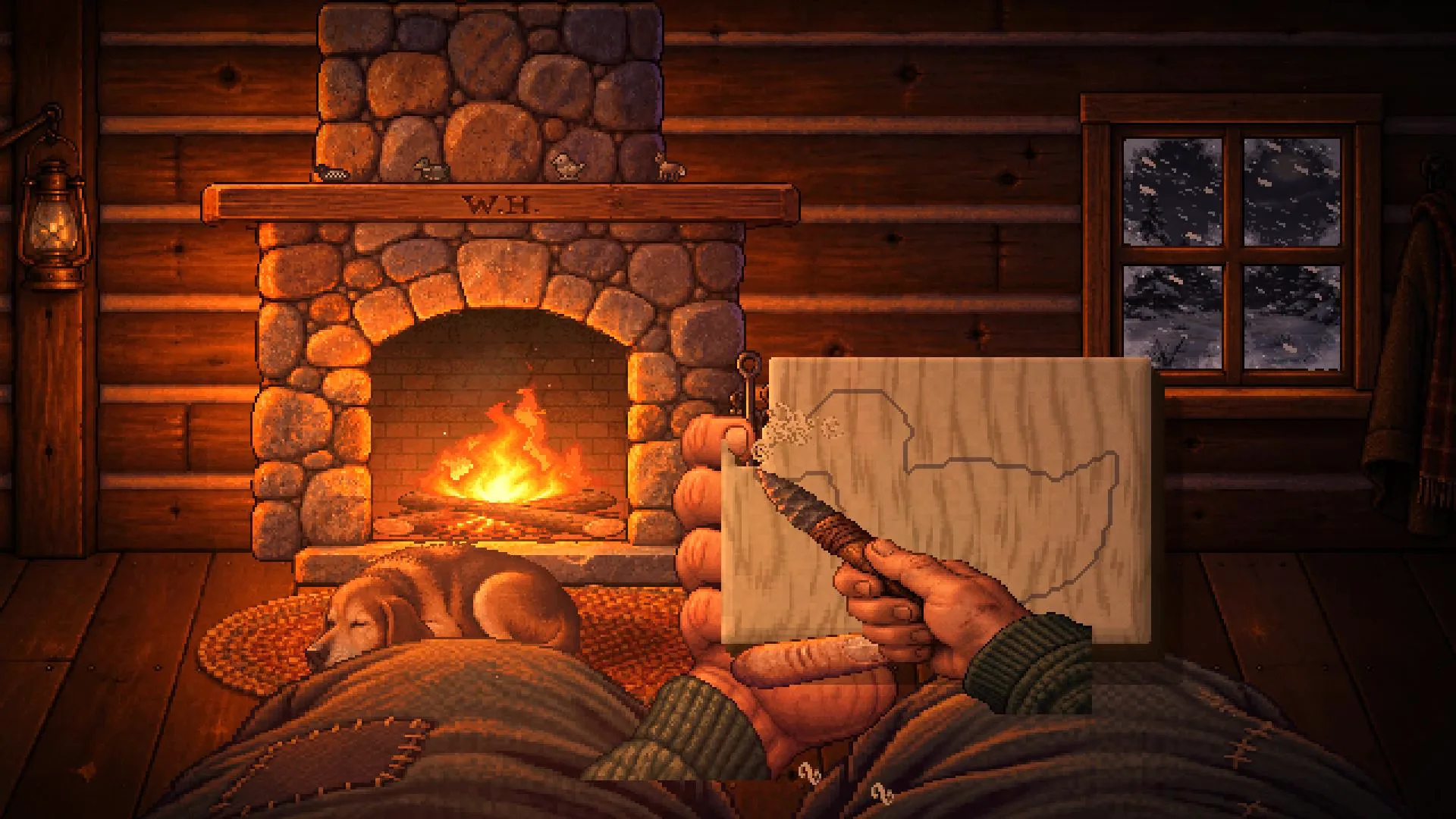
Handwork by the fire: "Whittle by the fire" now sits you down in the painted fireside scene by your own hearth.
The soup pot, the brew kettle and the dye bath are tended close in at the hearth (or at a fire ring in the snow): the fire burns under the pot and lights the whole scene, the pot hangs from the crane and swings off with it, and your hand comes in with the spoon when you stir. Click the pot to stir it.
The pot itself shows how it's cooking: still and dark when it's cold, a lazy simmer with a few bubbles at the edge, a rolling boil heaving over the whole top, foam climbing the sides, a brown ring where it's catching on the bottom, and grey smoke once it's burning. What you put in floats, sinks and tumbles in it, and feeding the fire sends sparks up.
Brewing shows its steps in the kettle: a lumpy porridge of a mash, hops tumbling in the boil, the kettle set down on the hearthstone in a tub of cold water (or packed in snow) to cool, and the scalded crock steaming beside it.
In the dye bath a skein of wool hangs in the pot and takes the colour as the dye draws, the same colour a rug dyed with it will be; a hard boil dulls it toward brown. Once the colour's drawn it's lifted out, dripping.
The soup pot's and the kettle's gauges sit on a small slate beside the pot, with the early, midway and late windows marked, and their buttons in a row under the hearth, so nothing runs off the screen.
With touch on, the fiddle's strings are labelled G D A E instead of blank keys.
Baking happens at the table and the oven. Your two hands knead the dough, which squashes, springs back and goes smooth and glossy as you work it, and flour puffs up at every fold; a clumsy fold tears it. It rises in a yellowware bowl under a towel, and a poke leaves a dent that springs back, fills slowly or stays, just as the words say. Then it goes into the oven you're at, a clay oven, a wood stove or a cookstove, with its fire burning in the firebox, a brass dial for the heat, and the loaf browning (edges first) when you open the door to look.
Tying a snare: twisted cord in your two hands, tied round a sapling on a game trail in the snow, the knot forming as you pull and the slack going out of it as it tightens. A slack pull leaves a turn loose, the wrong way kinks it, and too hard frays the cord.
Dressing a wound: your own forearm, in your own skin, on a blanket by the fire. The pad goes on, the linen is wound round one way and back the other, layer on layer, and tied off, and less blood shows through a careful wrap.
Nailing: up on the frame against the sky, with a much bigger nail, held by your left hand for the first tap while your right swings the hammer over it. Its shadow on the board between two pencil marks shows a clean stroke. The nail sinks a step with each clean blow, a glancing one dents the wood, and a bad one folds the nail over.
The night sky fills the screen: the Milky Way running through Cassiopeia, a field of stars of every brightness and colour that turns with the sky, the northern lights on some nights, a falling star now and then, and the cabin's lit window and chimney smoke below. Your hand points where you look, and traces the Dipper and its pointers when the hint's up.
Mending, waxing, lining, patching and quilting happen in the painted fireside room, the garment over your knees in its own weave and colour, lit by your fire. You see the tear close stitch by stitch in the thread you carry, a loose stitch hang slack and a tight one pucker the cloth, the wax darken the cloth where you rub it in, and a quilt's squares draw together as you quilt them, with your own hands on the needle and the wax.
The fiddle is the one under your chin: its four strings are the four lanes, the notes run down them to the bridge, the bow crosses to the string you play and the rosin flies off it. By your own fire the dog lifts an ear while you play well; out of doors you play by the camp at night or in the yard by day, and at a raising the crew heaves the wall frame up on your beat.
Whittling where there's no hearth to sit by (at a campfire, or in a house with no hearth yet) is a proper scene too: a fire in a ring of stones out of doors, the bench by the lamp indoors, the blank shaded like real wood and the knife in your hand.
On a phone or a 16:10 screen, the fireside room carries on past its edges instead of stopping at black bars.
On the rapids, your hull and the water aboard are shown beside the river instead of on top of it.
Fishing from the bank: the lake, the sky and the far shore change with the hour, with a gold road on the water at sundown and stars over it at night. You hold the rod and reel in your own hands: the rod bows as the line tightens, the line sags as it slackens, and you can see the fish run, boil and leap. The tension gauge is a small one beside the words.
Ice fishing is a cut through the ice: your hand on the jig rod over the hole, the light falling into the dark water, and fish that show what they want. They hang back, turn to watch the lure, nose it, take it, or bolt when you strike too soon. The time you have left is the daylight fading down the hole.
The rapids: the whole river is drawn round you from above, with the dark tongue down the clean line that a paddler reads, foam piling on the rocks, standing waves and holes, eddies along the banks and spruce going by on both shores. You see the paddler's strokes, spray off the paddle, and the water you've shipped in the bottom of the canoe.
Moss, needle litter, ash and lichen lie in drifts and patches across the wilds, no longer in diagonal rows of the same stamp.
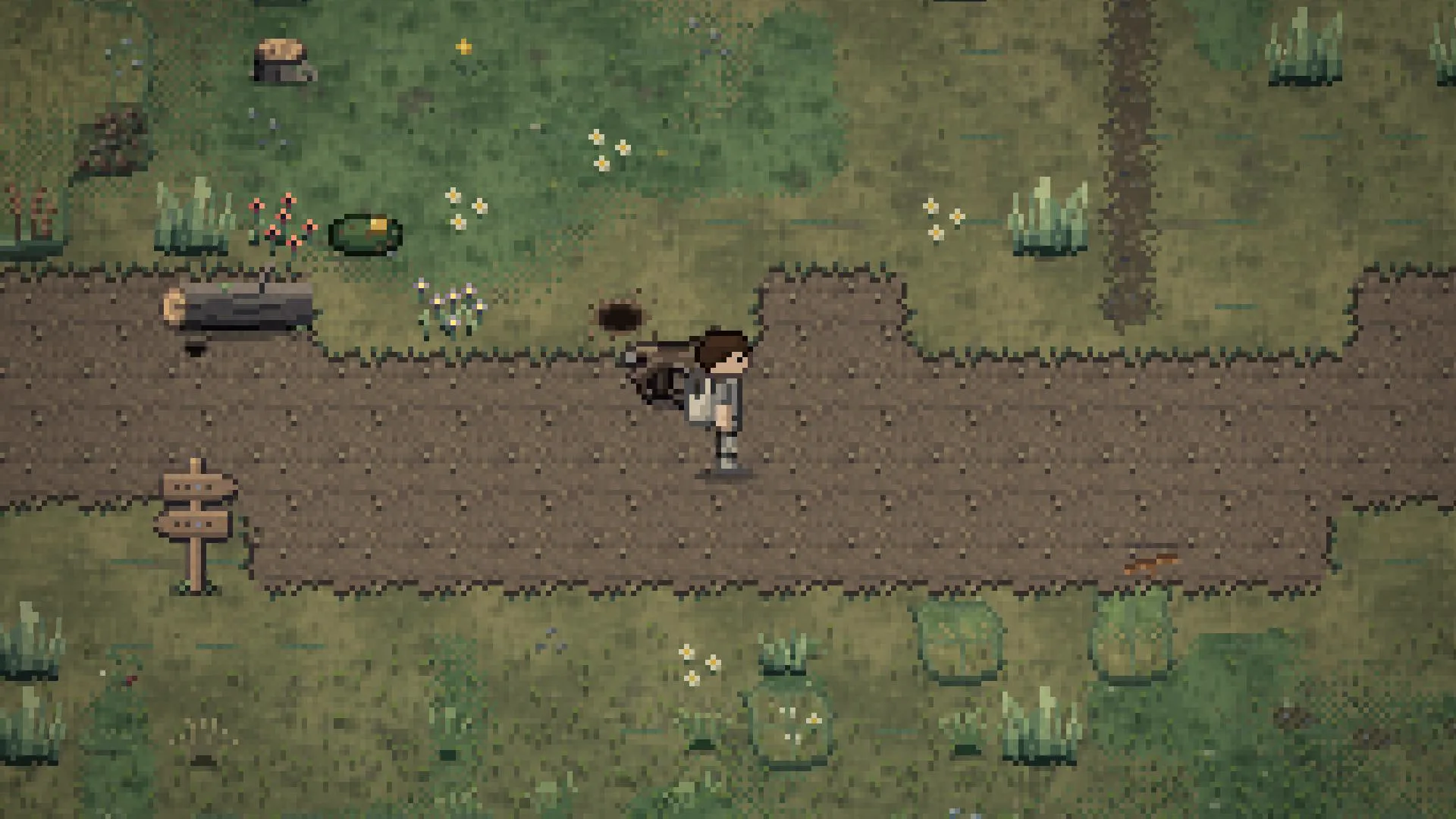
The old trails are narrow footpaths that wander a little and bend round the trees beside them, with the grass creeping in at their edges and a trodden trough through the snow in winter, where they were staircases of brown tiles.
The homestead looks lived in: woodchips round the chopping block, bark by the woodpile, an ash ring and scorched grass round the fire, sawdust at the bench, mud by the well and the rain barrel, a drip line under the eaves, a worn patch at the door and paths beaten from it to the things you use. They follow whatever you build or move.
The fen is a living bog of moss cushions, peat and standing water, with wet, dark banks and sedges in the shallows, where it was dark mud.
High snowfields in summer are old grey snow, pocked and gritty, shrinking as the summer goes, with wet scree where they melt back.
Open grass has its own lumps and bumps: tussocks and weeds in the long grass, molehills, ant mounds, puffballs and half-sunk stones in the short.
Millbrook's square has kerbs along some of its edges and broken stones with grass coming back along others, moss in the joints, a track worn pale across it, and snow that lies in its joints and banks against its edges.
The broad shading of the grass and the dusty stretches of road no longer show a checkered dot pattern at their edges.
Your house is lit by its own light. The light that tells you where you can read and work is the light you see: a pool round each lamp, the firelight reaching as far as the fire's big enough to throw it, the day brighter by the windows. A room with no fire or lamp goes cold and dark at night.
A fire doesn't light the room behind a wall any more. Its light comes round through the doorway.
Furniture stands on the floor: everything has a soft shadow where it meets the boards and between its legs, and what hangs on the wall casts a little shadow on it.
Sunlight through a window lies on the floor as the window's own shape: the panes and their cross, a narrow slot between curtains, slats through boards. It lies under the table and you, not over them, long in the morning and evening and short at noon. Lightning flashes blue through the windows.
The hearth's light breathes with the flames. A big fire sends sparks up, and the floor before the firebox glows. When the fire goes out, its embers glow red under the ash for an hour.
A lit sauna stove or kitchen range glows on the floor before it, and after dark the fire below glows up through the loft hatch.
Rooms with many lamps draw faster on phones.
On a phone or a tablet, ice fishing and baking have big buttons: through the ice, Raise and Lower for the lure's depth, Jig to twitch it and, set apart, Strike to set the hook; at the oven, Knead (or tap the dough), then Poke and Bake, then Open, Add wood and Take out.
The die beside your name on the new-game page gives you a whole new settler: a name and a look to go with it (skin, hair and hair colour), different with every throw. Change any of it after as you like.
Resting goes by quicker: a two-hour rest in the Rest window is over in about four seconds instead of six, and an hour sitting at rest in a seat passes in about seven seconds instead of ten. Each hour rests you just as much as before.
Rest by a burning fire (your hearth, a stove or a campfire, within a few steps) and your energy and health come back about a third quicker. The resting line and the Rest window say when you're by the fire; a cold hearth does nothing.
On a phone or a tablet, with something to eat, drink or put on in hand, the Use button steps aside: the Eat button shows it already. The other buttons stay where they are.
On a phone, the buttons down the right stand further in from the bottom corner, clear of a rounded screen corner (it hid half of Use), and Dodge and Block move with them.
Indoor floors sit a shade darker and quieter than the furniture on them, so a chest no longer vanishes into the dirt; boards run long with their joints and nails, and the kitchen, sunroom and smithy have real flagstones instead of a grid of squares.
The path you walk most wears into your floor: the boards polished along it, the earth trodden hard and dark. It fades if you stop using it.
Dirt in a room gathers along the walls, into the corners and round the furniture, and a sweep clears the open floor first.
Log, board, plaster and papered walls vary along their length (knots, splits, nails, cracks, a seam in the paper), so they no longer repeat every step.
Soot darkens the wall round an open fire; a lined hearth leaves less, and a masonry heater hardly any.
The walls between your rooms are proper walls, a log or boarded top with its end showing over the doorway.
The loft feels like it's under the roof: rafters up the back wall, a little gable window letting in the day, and at night the fire's glow coming up through the hatch.
The root cellar feels underground: roots and damp in its stone walls, shelves that show the jars you keep down there, daylight under the hatch, a slow drip, and dim enough that a lantern earns its keep.
Millbrook's shops and the ruins have walls with depth, a beam overhead and windows where the buildings have them.
A counter's Sell page and your Market Crate mark what's wanted this week and what's going cheap, and a thing's price says why it's up or down.
The coach says how much the week's prices put on your crate, and the Sleep window says where the day's coins came from.
Smoke you can read from the yard: your chimney sends up a column of soft puffs that rise, spread and fade, thick when a log's just gone on, thinning as the fire burns down to a thread over the embers, and none once it's out. It goes straight up on a still dawn, leans and tears in the wind, and shows grey against the snow.
Campfires send up a wisp by the wood left on them, and Millbrook's chimneys smoke with the town's day: every house on a winter morning, breakfast and supper fires, the inn's kitchen all day, Anders' forge dark while he works. There's always a thread from Kells' Post and Silas's hut.
Bare rock is shaded as whole masses lit from the sun's side (the east of a morning, the west of an evening), with long fissures, grass in the cracks and crusts of lichen; in winter the snow lies on top, packs the cracks, and the knobs stand out of it.
The axe's rhythm shows on the wood. Each strike throws a ring round the cut that closes in and turns gold: strike again while it's gold and you're chopping in time, and the pips above it fill, up to five. Each blow in time bites deeper and glances off knots less (it always did; now you can see it). Holding the button still chops steadily.
You can hear the rhythm now too: each blow in time, with the axe or the pick, rings a note under the strike, a step higher for each one in the run.
Leave in the middle of the summer at Grandad's (a call, a closed tab, a phone gone to sleep) and Continue on the title takes you back to the lesson you'd reached, as the settler you came as, instead of New Game and the whole summer over again.
Starting a new game takes one click: Begin is right on the settler page, with your six scores thrown for you and the summer at Grandad's ticked beside it. Roll scores is still there if you'd rather throw the dice yourself, and Enter in the name box begins too.
Ride to... is quicker than walking now, and when you ride out from the saddle you arrive still riding.
The horse you already had becomes the steady mare and keeps her name, waiting in her stall (or tied where you left her).
Firelight, lamplight and your lantern fall in warm bands, white-gold at the heart to a dim orange rim, on the same pixels as everything else, instead of blurry dots round every fire.
Lit windows throw their lamplight on the ground in front of the house at night, the shape of the panes faint in it, at home and in Millbrook, warmest on the snow.
On a clear night under the moon, trees, stones and the house cast faint blue moon shadows that swing as it crosses the sky.
At sunrise and in the golden evening, trees and stones catch a warm edge of light on the side facing the sun.
In winter, plants and trunks rise out of little mounds of snow instead of standing on grey plates.
Under a low sun, lakes and rivers stay a cool blue-green with apricot and rose light on the ripples and a warm band toward the sun, instead of going a muddy purple.
Dawn mist lies low over the water, the fen and the damp ground, with the trees standing up out of it, and burns off through the morning, instead of veiling the whole view.
Fog, cloud shadows and the darkening edges of the night are drawn on the game's own pixels: no more fine dot screen over the night sky.
Fixed
On a screen the game fills at an odd scale (a phone's browser with its bars showing, a Mac in full screen, most browser windows), the world holds still as you walk: the dappled shade under the trees no longer creeps a pixel against the ground and the paths beneath it, and the flowers' heads, the grass and the edges of things no longer step a pixel to and fro.
A game of the hands put away with its x (or Escape) is put away. It used to play on out of sight: a knot you gave up on read the arrow keys you walked with, a hammer struck at every Space, a fish fought on, and when one finished it shut whatever window you had open then (and a hidden knot or hammer could finish the job for you). A fish on the line or under the ice that you put away now gets away there and then, and the rod's yours again.
On a phone, the game in the browser no longer reloads itself a minute or so after you Continue (at once, in the cabin). The music and the sounds of the woods and the house now play a little at a time, as they always have on a computer, instead of each being held whole, which took more memory than a phone's browser would give the page; and a dream's big paintings are let go once it's over.
A hare or a chipmunk beside the loose stones you click no longer turns the click into a grab at the animal or a swing of your pick: the stones come up. An animal on the very spot, or one that's after you, still gets the click.
The soup pot no longer runs off the bottom of a 1920x1080 screen; "Swing off" is always in view.
On a phone, Continue as the screen turned for full screen could leave the HUD over a black screen. The game now waits for the screen to settle before it loads, and if the world is ever not showing, it puts it right at once.
On a phone, going full screen keeps the screen the way round you're holding it, and once you leave full screen yourself a tap no longer pulls you back in (the Full button does).
The kitchen range cooks by its own fire, not the hearth's: a soup won't cook over a cold range while the hearth burns, it will over a fed range with the hearth out, and the pot starts as hot as the range's own fire.
A cold range or a cookpot in the house no longer adds to the Hearth's light; only a fire that's burning lights the house.
Out of doors, a cookpot, forge, kiln, furnace or clay oven is no longer a fire that never goes out. Standing idle it doesn't warm you, glow, or keep the wolves and the little people off; a kiln or a furnace burns while it's firing a batch, and goes out when the batch is done.
Jigging through the ice, Space twitches the lure without striking at the fish too (every jig used to spook it), and the next time you jig the window no longer opens stuck.
E sets the hook when jigging, and pokes the dough or opens the oven when baking, as the words say (only F did).
A fish on the line, the rapids, the oven, the forge and the other games of the hands hold still while the game's paused for you being away, instead of running on behind the Paused card.
On a phone or a tablet, the tap on the Paused card that brings you back does only that: it no longer also strikes at the forge, reels the fish in, or (held a moment) opens the menu of a slot under it.
On a phone or a tablet, a thumb set down on the left of the screen always becomes the thumbstick; one that first moved only a little used to look about instead, and never walked you.
A spill on the rapids leaves the canoe in the water at the bank beside you, as stepping ashore does, so you can get back in and paddle on. It used to be left up on the dry bank, where getting in left you sat on the ground, stuck; a canoe the river left there before is dragged down to the water when you get in.
Loose stones, fallen branches, mushrooms, grass and the like come up in your hands whatever you're holding. A pick, a shovel, a hoe, seeds or a club in hand used to swing at them or do nothing. What's meant for the job still does it: a knife or the scythe through the grass, the pick at a flint nodule, a shovel lifting a sapling.
A click or a tap on something a walk away is done when you get there: stones picked up, a swing of the axe or the pick. You used to arrive and just stand there, and it happened later, from wherever you'd walked on to.
Ripe berries on a bush, and grubs in a rotten log, are picked again with an axe on your hotbar; the axe was taken up and the bush cut down.
Chairs at the end of a table sit in the middle of that end, not level with its top or bottom edge, and tuck in under it the same at either end; a single chair along a two-tile table sits in the middle of it. You sit where the chair is.
Your curtains keep the hours: drawn at dusk when the lamps light, opened at dawn, and stirring when the windows are open on a warm day or a gale comes through bare windows.
The weather shows in the dark round your house: rain and snow falling past it, and in winter snow banked against the front wall. In a blizzard, snow sifts in past bare windows and heaps on the floor under them.
A house left to freeze rimes over: frost creeps along the foot of the walls and round the window frames, and goes again as the fire warms it. Your breath shows in a cold room, and faint heat rises over a big fire.
At night the glass in your windows catches the lamplight, and on a clear night the moon rides in a pane.
Yesterday shows about the house: shavings where you whittled, sawdust by the bench, bark chips by the hearth, dishes on the table after a meal, your wet boots by the door, the mending basket by your chair, a book left open on it. The broom or a day clears them away.
New rooms come with a few humble things of their own: a straw bed with a crate beside it in a new bedroom, a worktable, a stool and a barrel in a kitchen, a bedroll and a blanket chest up in the loft.
Small lives about the house: moths round a lit lamp on summer nights, a spider let down from the beam in a room gone grimy, the old dog's back rising and falling as he sleeps.
With your pack full, what the house's new fittings push out of the way is no longer lost: a mirror where a west wing's window goes in, a cabinet where the fireside bench goes, and what was in it, are set down on the floor at your feet as you come in.
News that came in just as you opened a window, and the hint along the bottom, no longer catch the taps and clicks meant for the window once they've faded out of sight behind it: a tap on the dough as you knead, a button on the right of a window.
Improved
What a room's improvements bring now stands in groups, not in a row along the back wall: the night table at the head of the bed with flowers on it, the quilt rack at its foot, the washstand and the tub in corners, the rocking chair beside the fire.
The sunroom has windows the length of its wall; the cedar sauna shows its cedar, with steam and a warm haze while its stove burns and wet boards by the tub; the kitchen has copper pans hung from the beam and flour in the air by day.
Millbrook's shops show their trades: jars, sacks and bolts of cloth at the store, soot over the smithy's forge and its tools racked, herbs drying at the herbalist's, hides at the trading post and the trapper's.
The ruins look abandoned: daylight through holes in the roof, cobwebs in the corners, leaves and moss blown in, the burned cabin's floor scorched, and snow drifted in under the holes in winter.
The wall clock's pendulum swings a beat a second.
Fixed
The candelabra, the hurricane lamp, the forced bulbs and the geranium can stand on the mantel and in the curio cabinet, like the other things for a table.
Curtains hang in front of the window they're drawn across, not behind it.
Deer no longer fade away where they stand: at the meadow's edge they walk back off into the trees, or bound away if you startle them, and are only gone once they're out of sight.
Small birds that land stay a while, looking about on a branch or pecking in the grass, then fly off out of view; walk at them and they're up and away. They no longer vanish into the leaves, and the visitors to your feeder and the robin on her nest fly to and from them instead of blinking in and out.
No animal pops into view or disappears in plain sight any more, even zoomed out or with the view dragged aside: wolves slink off at dawn, a fox runs off with the hare in its jaws, ducks fly away, a carcass is cleared only once you've looked away, and new arrivals walk or fly in from beyond the edge of the screen.
0.9.26 · 9 October 2026 · Many Hands
New
Click and drag on the world (or hold a finger and drag) to look about; the view slides back to you as soon as you move. The middle mouse button drags it too, and a click still does just what it always did.
A die beside your name on the new-game page gives you a fitting old-fashioned settler's name at a click or a tap, a new one each throw, and you can still type your own.
Drop part of a stack: a thing's menu offers Drop one, Drop all, or a slider to drop as many as you like.
On a phone or a tablet, small buttons by the pause mark open the controls, your character, a quick save and full screen; hints name the buttons to tap instead of keys.
On a phone or a tablet, push the thumbstick all the way out to run, and a Block button comes up when something's after you (hold it to brace, or to stand tall empty-handed).
Improved
The broadleaf trees are coming into leaf from the first morning of spring (each on its own day, all in full leaf by the fourth), so the clearing you arrive at no longer looks like winter still.
Your starting shirt, trousers and foot wraps have colours of their own, so you stand out against the grass and the snow.
Millbrook's villagers have portraits when you talk to them, and Anders, Hazel, Elias and Wren carry themselves more like themselves.
Deer, goats and bears have truer shapes; maples and birches fuller, more natural crowns through every season; the cabin's plank floors are calmer underfoot.
Whittling by the fire, the wood in your hands catches the firelight, warm on the near side, so you can see the shape you're carving.
A pass over the game's words: clearer instructions and descriptions, and friends who say what they mean (and what they actually give you).
Chairs face the table they're set beside, tucked in under its edge (side-on at its end, front or back along it), and a seat by the fire faces the fire; turn one yourself and it stays as you turned it. Houses already furnished are set right too.
The right tool is used for what you point at: an axe for a tree, a pick for stone, a shovel for clay, taken in hand from the hotbar if it's there. Without one, clay and the like are gathered by hand, or you're told what it wants.
The soup pot cooks through in about half the time, and a "Next:" line says what to do now, with its button lit.
Firewood, logs and hardwood burn about a third longer.
What you do with a thing says so: Eat, Drink, Take a tonic or Apply a bandage, on the touch button, in its menu and in its sound.
The tutorial's highlight ring is drawn in pixel art, on the same pixels as the world and the buttons.
On a phone or a tablet: hold a finger on the fishing window to reel; tap the crafting window to strike; knots, bandages, the rapids and the grindstone have big arrow buttons; tap a fiddle string to play it, and the forge to time each step; the whittling knife and the wax follow your finger; with a stack in hand, a long press on a slot sets down just one.
New Game asks before it replaces your game in progress, and keeps the old one as a backup; saves are written more safely, and a damaged one falls back to the save before it.
Clicking to walk goes round open ravines and your own bear traps, and a fall stops the walk.
Fixed
A click on the hearth at home opens its menu even with a knife in hand (whittling is one of its handwork); it used to talk only of whittling.
A cold hearth or stove is dark, not showing a dull grey fire.
Cut scenes move at a reader's pace, about a quarter quicker, and a click or a tap moves on to the next line instead of skipping the whole scene (on a tablet, meeting Sultan ended before it began). Two quick taps, or Esc, skip the rest.
On a phone or a tablet, tapping a text box brings up the keyboard, and name boxes no longer bring it up by themselves.
If the browser takes the game's picture away while it's out of sight, it says so and a tap brings the game back, instead of a black screen.
Skipping the prologue as the last evening fades in no longer leaves the screen black or you frozen.
Dying in your sleep no longer runs the rest of the night and a second day after.
Time no longer passes while a dream or a night together plays.
Campfires burn down while you sleep, while you're indoors or away, and out of sight; a fire nearly out no longer keeps the cold and the wolves off all night.
Sitting no longer speeds up the hours while you're hungry, thirsty, cold, bleeding or hurt, or in the last hour before 2am.
The hours you sleep through pass properly: rain fills the barrels, snow settles and melts, and Tom works on.
Going to sleep no longer lowers your energy; short of food in your first nights, what you have restores energy at the first nights' rate.
Eating or drinking straight from a chest or the Market Crate uses up what you ate (it used to come free).
Old food put onto a fresh stack keeps its own spoil date: the stack keeps the earlier one.
Frugal no longer gives your materials back twice when a craft fails.
Hammering up a bed, table or chair gives back its quilt, curtains, tablecloth or cushion.
Moving a group onto a table sets candles and small things properly on it, without wiping out the table.
Undo turns a piece back the way it faced, and a blocked undo stays in the list till the spot is clear.
A new fixture that bumps a table into your pack brings back what was on it too.
A dock moved or stored takes its planks with it; a snare or harvest display moved in build mode keeps its place on the round.
Ice closing round your canoe overnight puts you on the bank with the canoe beside you; ice rotting under you overnight lets you through instead of stranding you.
Dying in the canoe no longer leaves you stuck "boating" in the cabin.
Saving while seated no longer leaves you stuck in the chair when you Continue.
A bear or the little people at your door no longer vanish on loading a save, or follow you into a new game.
Things dropped down a mine wait at the mine mouth when you Continue a game saved there.
The harvest supper is always set for its evening, even with a friend coming the night before.
If you quit before the arrival or first-morning scene played, it plays when you Continue.
The peddler's cart pulls up beside what you've built instead of clearing it away.
Rosalind's letter about her visits arrives before her first visit, not after.
Friends who came up for the evening have gone home by morning.
Sharpening or forging a second time no longer opens a window that's already finished.
Getting up after your clothes changed while you sat or knelt (a hat put on, a torch burning out, a strap wearing through) no longer leaves a column of copies of you down the screen.
Quitting the game (or closing its window) after a piece of work like mending or clearing a trail no longer crashes on the way out.
On a phone or a tablet, a tap cut short by the game pausing (a notification, another app) no longer goes off later from a tap somewhere else (the Settings gear opened from a tap on the grass).
0.9.25 · 7 October 2026 · At Your Fingertips
Fixed
Seated in a chair, a tap (or a click) on the ground now gets you up and walks you there. On a phone you could only stand up with the thumbstick: every tap was lost while you sat.
On a phone or a tablet, things drag from one slot to another in the pack (and onto the hotbar, a chest, or out to set them down) with a finger as they do with a mouse. In the browser a drag never began: the pack only worked by tapping one slot, then another.
The abandoned cabin in the pines can be gone into: its door opens on a room someone left one winter, with a cold hearth, what they left behind and a note. It looked as if you could, and every other ruin out there lets you.
In every ruin, the note and the chest left behind are always there to find; now and then one was lost under the wreckage.
On a phone, a long press on a thing in your pack or on the hotbar brings up what you can do with it (Eat, Equip, Read, Drop, and the rest), as a right click does, with its description beside it while your finger's down. It used to show only the description, so there was no way to drop anything.
0.9.24 · 5 October 2026 · Steady Underfoot
Fixed
On a phone, or in a browser window of no particular size, the ground's pixels no longer shift and crawl under you as you walk. The world is drawn with every art pixel the same whole number of screen pixels wide, whatever the screen's size, so the grass holds still under your feet and nothing's pixels come out uneven.
Wildflowers no longer flicker between open and shut as you walk past them on a phone or a browser window of no particular size; each keeps its own moment to open and close with the day.
On a phone, the game pausing while you're away (a notification, another app) no longer leaves you running on by yourself when you come back, with the thumbstick deaf to your thumb. Whatever your fingers were doing is let go as it pauses.
0.9.23 · 5 October 2026 · Easy on the Eyes
Improved
Pointing at the house no longer brings up a card that follows the mouse about. A line by the pointer says what that part of the house is, how it stands, and when its next improvement is ready to begin with what you carry; click it (the door: right-click) for its plans, as before.
Build mode says what the room you're in still wants to be lived-in (somewhere to sit, a table, a light, something woven, something green, something on the wall), the nooks you've made in it and its style. With a piece in hand, it says how warm the spot you're pointing at is and why, and after dark how light.
Out in the yard, build mode no longer offers the Colour tool: nothing out there takes a colour.
Fixed
The Hearth's note about a room that's nearly lived-in names the room properly ("The main room is nearly lived-in").
0.9.22 · 5 October 2026 · A Place for Everything
New
More places to set things out: a dresser's top, either side of its looking-glass; a cabinet's top; along the top of a bookshelf. Click one with a small thing in hand (a candle, a carving, a keepsake, a find) to set it there. A dresser's or a cabinet's drawers open as ever, and show what's on top, to take down or put up from your pack. What's set out counts as set out, as on the mantel.
Fixed
An herb pot on a window sill is still there after you load your game or build onto the house. It used to vanish.
0.9.21 · 5 October 2026 · Several at Once
New
Choose several pieces and move them together. In build mode, Select (or Shift-click) chooses a piece or lets it go, and dragging a box round them chooses them all; click any of them to pick them all up, a table with what's on it and the chairs round it as they stand, and set them down somewhere else together. X puts them all into store, and Undo puts them all back.
0.9.20 · 5 October 2026 · Every Way Round
New
Turn your furniture. Beds go along the wall or across the room, the head to either side; tables, desks, chests, workbenches, the loom and the quilting frame go along or across; the settle, the daybed and the garden bench face any of four ways; rugs and the runner turn too. Press R (or Turn) with a piece in hand, or point at one already down in build mode and press R to turn it where it stands, with what's on it. A quilt, curtains, a tablecloth or a cushion turns with the piece, and you sit facing the way a bench faces.
Curtains hang at a window now, round it: point at the window with curtains in hand. Hung there they keep its draft out, curtain it for a bed nook, and net curtains keep the mosquitoes out with it open.
Improved
Pictures, trophies, coat pegs and the like take the wall they really cover (two tiles), so nothing hangs half behind another. Anything already up that no longer fits is moved along the wall, or into the house store if there's no room; curtains hung beside a window go round it.
0.9.19 · 5 October 2026 · Seats at the Table
Improved
The Colour tool's words say what it colours now: a rug, curtains, a piece of furniture or a wall. Naming a room for the first time with the box left empty takes the name it offered.
Fixed
Visitors stand at the seats round your table, not at a stool in another room.
0.9.18 · 5 October 2026 · Rooms of Your Own
New
Name your rooms. In build mode, Name room gives the room you're in a name of its own ("Grandad's corner", "the snug"), and the house calls it that from then on.
Styles. A room furnished all of a piece has a style: Settler (plain pine and spruce), Craftsman (oak and maple), Woodsman (fur and antler, birch and cedar) or Painted. Four pieces or more, most of what's styled in it: it counts for more in the Hearth, you're told the first time, and a visitor with a liking for that style notices it first.
Improved
A partner is content longer in a home they like: something they care for in the house (Linnea anything blue or a loom, Solveig furs and a good fire, Mae a working kitchen) eases the dark months a little more, and the contentment after an evening together lasts longer.
0.9.17 · 5 October 2026 · Company
New
Company. Friends from Millbrook come up the path of an evening: the first time the house is Snug, Cozy and Beloved, to see it; a friend now and then, once you're friends; and the harvest supper at yours late in the fall. You're told the day before, and the day book says who's coming.
A seat each at a set table, a room warm and lit, and something to put in front of them (soup, bread, a pie) make a good evening of it: friendship, your spirits lifted, and something left for you when they go. Each notices what they care for in the house: Marta a quilt or a well-kept pantry, Elias your books and the clock, Tobias a fish on the wall, Linnea anything blue, Wren furs and cloth, Hazel green things. With nowhere to sit, they say a few words at the door and go; not home, and they've been and gone.
0.9.16 · 5 October 2026 · Woods and Makings
New
New pieces for the house, each with a job. A daybed: lie on it in the afternoon for half an hour or more and the nap lifts you. A tea table: tea by the fire with one beside you does you more good. A worktable: beside it the soup pot's and the dye bath's timing is more forgiving. A rope bed: cheap, from cordage, better than straw.
A blanket chest: keep a quilt in it at a bed's foot and that bed's a degree warmer. A spice rack: cooking within reach of it comes out a little better. A firewood box: fill it and feed the hearth from it without going out to the woodpile. A quilting frame: with one in the house, quilts come out a grade finer and quicker.
A cat's shelf by a window: the cat watches the birds from it and mouses the better for it. Forced bulbs: a bowl of bulbs that flowers in the winter and lifts you while you're near it. A barometer for the wall: read it for tomorrow's weather, and from the window you read the sky right more often. A hanging basket for the beam, a geranium for a sill or a table, a hooked rug and a long runner that take any colour.
The barometer, the forced bulbs and the geranium come from the Hudson & Pine catalogue at the store.
Woods. A felled tree's logs remember what tree they were: pine, spruce, birch, cedar, oak or maple, and figured maple from the curl in an old maple's grain. Planks keep it, and anything made of one wood is that wood, drawn in it and named for it: an oak table, a birch chest. A finer wood counts for more in the Hearth, oak and maple more than pine, figured maple most of all. Woods mixed in the making give the plain look.
Finishes for your furniture, in the Colour tool: oil it with tallow (darker and richer), wax it with beeswax (a soft shine), paint it any colour with a dye and a lump of tallow, or whitewash it with quicklime. Each counts a little in the Hearth, and a painted piece is a colour in the room like a dyed rug.
0.9.15 · 5 October 2026 · Cloth
New
Cloth for the furniture you have. A tablecloth on a table: a meal at it lifts you more and keeps you fed longer. A cushion on a chair, a stool or a settle: it rests you better. Curtains round a bed: a degree warmer in it. Hold one and use it on the piece; in build mode, Take up (X) takes the cloth off first.
Quilts, made by the fire by hand (Handwork, with the needle): two colours and a pattern, nine-patch, log cabin or star. Laid on a bed, a quilt keeps you warmer, two degrees for fine work. The colours are any dyes you carry, or the cloth's own natural.
The Colour tool dyes a tablecloth, cushion or bed curtains where they lie, and the armchair's cover takes a colour too.
The dye bath: dyes are tended in the pot now, like a soup. A little salt in early fixes the colour (black's iron goes in early too), the plant midway, and a gentle simmer throughout: a hard boil dulls it. A good bath makes a finer dye, and so a deeper colour on what you dye, and a third jar. Quick dye skips the tending, for a paler one.
0.9.14 · 5 October 2026 · Colour
New
Colour. Rugs, curtains, tapestries and draft snakes take any of ten colours: build mode's Colour button shows the dyes you carry; pick one, point at a piece to see it in that colour, and click. A dye in hand on a rug works too. Undo gives the dye back.
Six more dyes, made in the pot like the first four: brown from oak bark, purple from blueberries, orange from rose hips, black from oak bark and scrap iron, pink from raspberries, grey from old man's beard.
Walls: whitewash any room, logs and all, with quicklime; paint boarded or plastered walls any colour with dye and a lump of tallow. A whitewashed room is lighter, by day and by lamplight, and the rats like the lime less.
One wool rug, woven in the natural colours of the sheep, to dye as you like. (The red, blue and green rugs you have keep their colours, and take a new one.)
Improved
In the fall and winter, colour round you at home keeps the gloom off: each coloured thing in the room you're in (painted walls count twice) takes a little off what the grey months wear on your spirits.
A dye has a quality now: a better dyer makes a deeper colour, and a deeper colour counts for more in the Hearth. A room whose colours go together (no more than two, with black, grey and white going with anything) counts for more again.
0.9.13 · 5 October 2026 · Nooks
New
Nooks: arrangements in your house that the game recognises, each doing something for you. A fireside (a seat by the hearth, a rug, a footstool or side table at hand): you rest faster there while the fire's lit, and tea by it does you more good. A set table (two seats at it and a light on it): a meal there lifts you more and keeps you fed longer. A reading corner (good light, a bookshelf): books read faster.
More nooks: a bed nook (a lamp on a bedside table, any window near it curtained) sleeps deeper; a work corner (a bench in good light, a tool rack or shelf, a stool) makes better, quicker work, unless it's below 10° there; a window seat, a cool pantry, a pet corner, a green corner, a washstand with a looking-glass, a mudroom corner and a music corner.
The first time you make each nook, a card says what it does and the Homestead Book keeps a picture of the room. The build panel's Nooks button shows the ones you've made.
New for the house: a footstool, a looking-glass, a dog bed (the old dog sleeps in it), a fiddle stand and a tool rack.
Improved
Seats rest you by what they are: an armchair half as well again as a stool, and a footstool beside one helps.
A room with somewhere to sit, a table, a light, something woven, something green and something on the wall is lived-in: it counts for more in the Hearth, lifts your spirits while you're in it, and you sleep better in it. Repeated pieces only count less within one room now: a chair in each room counts in full.
0.9.12 · 5 October 2026 · Lamplight
New
Lamplight. After dark the house's light is the fire's and your lamps': candles, oil lamps, sconces and the lantern on the beam now light themselves at dusk while you're home and awake, and burn tallow or candles while they do (a few evenings to a filling). A lump of tallow or a candle in hand fills one. They say when they're running low.
Work after dark goes better in good light: in a dim corner, crafting takes longer and comes out rougher, by a lamp it comes out a little better. You can't read in the dark. By day the windows light the house well enough.
A dark corner of the house after dark weighs on your spirits, as the dark outside does. A lamplit room doesn't.
New lamps: a candle wheel to hang from the beam (the brightest light there is), a floor lamp, a candelabra and a hurricane lamp. The build panel's Light button shows how light the house is across the floor.
0.9.11 · 5 October 2026 · Warm corners
New
Rearranging the house (B): taking a piece up now puts it into store whole, a chest with what's in it, a woodpile with its wood, a cask with its batch, a vase with its flowers. Set it down again from the build panel's Stored tab, or take it into your pack.
Undo while rearranging (Z, or the Undo button): the last ten moves, set-downs and take-ups.
Clear room: everything of yours in the room you're standing in goes into store, to start the room afresh or to do a wing over as another room. Undo puts it all back.
Where things stand in the house now matters for warmth. Each spot has its own warmth on top of the house's air: warm by the fire, cold in the door's draft, in front of a bare window and along the outside walls. A rug underfoot helps. The Warmth button in the build panel shows it across the floor.
Where your bed stands changes your night: by the fire it sleeps warmer, under a bare window or by the door colder. The sleep window says why, and the build panel says how warm a bed would be where you're pointing.
New for the house: a settle (by the door, its high back halves the draft), a fire screen (the fire's warmth reaches further), a draft snake for the door, a tapestry for the back wall, a box bed (the warmest bed there is), net curtains, and a hot stone to take to bed.
Open the windows on a warm day (the windows card) and the house cools. Leave them open on a summer night and the mosquitoes come in, unless net curtains hang beside a window.
A summer night that's too warm (above 24°) is harder to sleep through. You also feel a draft where you stand indoors: by the door, or in front of a bare window.
Where you keep food in the house counts: a chest or crock in a cold corner keeps it a little longer, and one by the fire spoils it sooner. The Larder's forecast knows.
The cat naps in the warmest spot it can find, out of the drafts.
Improved
A table moves with whatever's set on it.
When something won't go where you're pointing, the build panel says why ("Keep the doorway clear", "The rustic table is in the way"), and so does a click.
Furniture can't block the front of the hearth or the foot of the loft ladder (a rug is fine).
The pieces a room's improvements bring are set in once and then they're yours, to move, store or take up like anything you've made.
The build panel's tooltips say what each piece is for: a seat, a bed, what it holds, its light and its comfort.
On a touchscreen, the build panel has a Turn button for chairs (there's no R key), alongside Take up and Undo.
Fixed
The outline of a picture, shelf or anything else you hang on the wall now shows where it will really hang, and a lantern for the rafters shows up at the beam.
"R: rotate" only shows for pieces that can turn.
Food kept up in the loft now keeps longer in an ice box, a crock or on a pantry shelf, as it does downstairs. And the Larder's forecast now matches how long your food really keeps: a pantry shelf outside the kitchen and the root cellar's top shelves were counted wrong.
Climbing the ladder to the loft now puts you on the loft floor beside the hatch. Before, you came out past the edge of the room, out of sight, and couldn't move.
The loft now counts as being at home: the dark of night no longer wears on your spirits up there, and you rest and dry off as you do downstairs.
The cat curls up by the fire again after a west wing has moved the hearth along, and naps on rugs (it never did).
A cookpot, cauldron or clay oven in the house no longer counts as a fire that never goes out: it doesn't warm you, dry your clothes or glow all night. You cook at it as before.
The kitchen range and the sauna stove now burn down their wood while you're out of the house. Before, a range fed once kept the house warmer for as long as you were away.
The bed for two now goes in the bedroom, if you've built one, instead of the main room.
Taking up a vase keeps its flowers as they were (wilting flowers no longer come back fresh, nor an empty vase full), a chair goes back down facing the way it faced, and herbs taken down from the beam before they're dry keep the days they've had.
The Homestead Book's pictures now show the room you're in when the page is written, not a strip of the main room.
0.9.10 · 5 October 2026 · Home ground
New
Raise a cache on posts in the yard. Meat and fish kept up there don't draw bears, and in a hard frost it's a freezer: nothing in it spoils.
Build a dock at the lake shore, or at the end of a plank walkway. Fish bite better off the end of it, the canoe ties up alongside, and sitting out on it at first light or dusk lifts your spirits.
Put up a bird feeder and keep it stocked with nuts, seed or suet cakes (tallow and nuts, made at a campfire). Different birds come each season, each kind goes in your field notes, and in winter the birds make the dark days weigh less.
Put up a nest box by the middle of spring and a pair of tree swallows will raise a brood in it. All summer they thin out the mosquitoes and blackflies around your yard.
Set a trellis behind your beans or peas. Each picking gives one more, and the next one comes a day sooner.
Hang a swing beside a big tree in the yard. An hour on it on a fair day lifts your spirits.
Name your homestead: make a name board at the workbench and set it by the path. The name goes on your letters, on the Homestead Book, and greets you as you come home.
Improved
Raw meat and fish kept in a chest out in the yard now draw bears, the same as in the cabin. Keep them in a raised cache instead.
Fixed
A smokehouse in the yard now draws bears, as intended. It was being left out.
A new fixture going in where a cask stood with a batch working in it now rolls the cask aside, batch and all. Before, the batch was lost.
Outdoors, decorate mode now works only in your yard (the clearing around the cabin), not anywhere in the pines, meadows or birch woods. Walking out of the yard ends it, and anything you were moving goes back where it was.
0.9.9 · 5 October 2026 · Things stay where you put them
Fixed
Saving while carrying a piece in decorate mode no longer loses it.
You can no longer set things down in the mines, where they vanished when you left. Decorate mode now works only in your own house.
What you drop in the mines (from a full pack, say) is no longer lost when you leave: it's waiting at the mine mouth.
The hammer no longer takes furniture that came with a room (it used to come back, leaving you two), or a shop's or a ruin's fittings.
Taking up a woodpile in decorate mode no longer loses its firewood.
Taking up a fermenting cask no longer loses the batch: draw the beer off first.
With something picked in the build palette, clicking a table, shelf or curio cabinet now sets it on or in it instead of lifting the furniture.
Clicking a bare cabin wall with a painting, sconce, curtains or herbs in hand now hangs it instead of opening the Walls card (right-click for the card).
When a new fixture goes where your things stood, everything comes back to your pack, including a cabinet's curios, a shelf's things, firewood and pictures on the wall.
Doing a wing over as another room gives back what was kept in it: the food on its pantry shelf, and your chests with what was in them.
Nothing can be hung behind the hearth's chimney or the loft ladder any more: a shelf hung there was hidden behind the stones, or replaced the ladder. Anything hung there before you built the hearth comes back to your pack.
0.9.8 · 5 October 2026 · Signs and blazes
New
Ask around. Kells at his post, Silas at his hut and Ida at the rail camp will each tell you, once a day, of somewhere worth the walk: an old cache, an empty house gone to ruin, a prospect, a gravel bar with gold in it, a bee tree. Each goes on your map as a "?".
Old axe blazes on the trees along the trails to the old caches. Each one points on to the next (hover over the tree to see which way), and the last to the cache.
Your map keeps the caches and ruins you've seen and not yet opened, and the journal's Far Country page counts each region's finds.
Improved
Treasure maps always show somewhere real now: a rough circle round a landmark, out in the backcountry, named on your map. An old map too faded to read shows where it means when you read it again.
A falling star's map now points out into the far north.
The very best finds (legendary) only turn up in the far north now. Near home the best of any find is epic.
Luck lifts every find now, even a find that's already rare or better (it used to make no difference above the lowest).
0.9.7 · 5 October 2026 · Where it leads
New
Every keepsake set, once you have the whole of it, now points somewhere, and the place is circled on your map.
The Three Partners lead to their claim above Cold Tarn: their gold, their claim papers, and the quartz seam itself, which you can work once a week with an iron pick.
The First Survey leads to the surveyor's last cairn and his transit. Carry it up a lookout and you see twice as far; at a summit cairn, take a sighting over the whole country.
Ferris Creek leads to the town bell, buried in the creek bank in the Burn the night of the fire. Hang it at home and ring it: the dog comes, and your horse comes home from wherever she's tied.
Grandad's things lead to his winter cache out on his old line: supplies, and his old fur coat.
The House in the Wood: let the jay go, then look in the pantry. Pearls and precious stones, as in the tale.
The First People's birchbark map is an old canoe route. With a canoe in your pack, paddle it from a landing near home out to the far country and back; at the far end there's a stone to sit on a while.
Soapstone and mica, from outcrops in the Sawtooth. Soapstone carves at the whittling bench, and faces the heat bank in Cabin Plans: the cabin keeps warm four hours longer.
Figured maple, now and then, from an old sugar maple felled out past the second ring. It saws into Superior boards or better.
Two new looks for the house, from the far country's stone: a slate roof (slate from the ridges, a roofing job in the style tab) and isinglass windows, small panes of mica that glow amber at night.
The journal's Places page lists the far country and what each region is known for, once you've been there or asked Kells at his post what's out there. The Frostpeaks count among the far regions now.
Fixed
The journal's "Regions explored" count used to add far regions you'd been to onto its home total, so it could run past ten while listing nothing new. It counts the nine home regions now, and the far country is listed below it.
0.9.6 · 4 October 2026 · Prime furs
New
Pelts and hides have a grade now. Winter fur is thick and prime; summer fur is thin; an arrowhead through a hide costs it a grade, while a snare, a deadfall or a blunt arrow leaves it whole. Prime pelts make warmer garments and fetch more, and the fur buyers' contracts ask for them. Pelts in an old save come up Standard.
New gear from the pelts nobody had a use for: a caribou parka (the warmest coat you can make), a wolverine ruff for the neck, a beaver hat and beaver mitts that shed the wet, and a lynx hat, the warmest hat there is. All are made at the tailor's table, and all show on you.
Hide work: dry a hide on the drying rack into rawhide, to relace snowshoes (or make them); or tan one soft with fat and smoke it in the smokehouse into buckskin, for a fringed buckskin jacket and buckskin mukluks that keep the damp out.
Ducks give down. Line a garment with it by the fire: as warm as fur for its weight, but useless soaked. A garment can be lined with marmot fur too.
A bear robe (the tanning rack): carry it, and wherever you bed down out of doors the night's cold stays outside it.
A snakeskin hatband and quillwork trim, stitched on by the fire: dressed in something fine, your spirits wear down a little slower.
Improved
Soaked through, each garment keeps the warmth its own waterproofing saves, so a beaver hat or a waxed coat matters, not only your coat and trousers. The weather window shows how much of the wet every piece keeps out.
In a cold snow your breath ices a scarf or a cowl and it keeps less of the wind off; wolverine fur never ices.
Fixed
Relacing snowshoes and stitching a canvas shell can be done from the handwork window by the fire. Before, those two jobs wouldn't start there.
0.9.5 · 4 October 2026 · Into the wind
New
The wind bites. Out in the open (the barrens, the lakes, the peaks) a stiff wind takes degrees off how warm it feels; in the trees, much less. Clothes keep it out by what they're made of: leather and oilskin most, fur about half, wool little. By the fire you can stitch a canvas shell over a coat or trousers. The warmth tip says when the wind's at you.
In hard cold, thin mittens let your fingers go numb (clumsy at any work, and no good on a bowstring) and thin boots let your feet freeze in the snow (slower going). A fire brings them back.
A slot at the neck: a red wool scarf or a fur cowl (the tailor's table), for warmth and to keep the wind off your face. The scarf shows.
Snow blindness. Hours out on bright snow under a clear sky burn your eyes, and the world goes a white blur for a while. Slit goggles, carved from antler at the workbench, prevent it if you carry them.
Snow shelters. In winter, with a shovel, dig a shelter into a big drift instead of clearing it (two hours). Sleep in it and the night's far warmer than out in the open. It lasts till the thaw.
0.9.4 · 4 October 2026 · Dressed for the cold
New
Snowshoes and crampons have a slot of their own, over your boots, so they no longer push your charm out. In an old save they move across by themselves.
Snowshoes show on you, and their lacing wears through on deep snow: relace them by the fire with leather and cordage.
Crampons do what they say. Run on ice without them and now and then your feet go out from under you.
"Dressed for the weather" on the character sheet: each part of you, how warm it's kept and how dry, and how long you'd last on the move at three hard frosts, dry and soaked.
Fixed
Double Stitch makes the clothes you sew wear half as fast, as it says. It used to make them a little rainproof instead.
Frostbite slows your work, as it says: projects and chores, and the axe and the pick.
0.9.3 · 4 October 2026 · A lived-in house
New
Hang things from the ceiling beam. Click the back wall with herbs, mushrooms, onions or garlic in hand to tie them up to dry. Herbs stop going off, mushrooms dry into dried mushrooms, and onions and garlic cure to keep two months longer. A lamp hung there lights the room. Right-click to take anything down.
The vase takes the flowers you pick: click it with them. They're fresh for a few days, then go over, and an empty vase does little for the room.
An herb pot for the window sill (workbench: a clay jar and compost). Click a window with it, with a cutting of wild mint, chamomile or yarrow in your pack, and after a few days there's some to pick every few days.
The house keeps the seasons. A wreath of spruce and rowan hangs on the door in winter, inside and out. The harvest sits by the door in the fall and keeps till the frost. On the longest night, set a candle in every window.
A wing can be done over as another room for about a third of what building that room costs: at the plans desk, beside the room. Clear your things out of it first; its fittings and improvements come out with it.
0.9.2 · 4 October 2026 · Show what you've found
New
Shelves and a curio cabinet for what you find. Set keepsakes, carvings, and the stones, gems and relics you find on a wall shelf (two spots) or in a glass-fronted curio cabinet (nine, from the carpentry bench). Click one with a piece in hand to set it there; right-click to take things down. They stand there as little figures and count as set out, just like on a table. A whole collection set out (every stone and gem, or the relics with Old Scar and the white stag) lifts your spirits each morning.
Mount your biggest fish. Hang a trophy board (carpentry bench) and click it with a fish in hand: it's mounted, the biggest you've caught of that kind, with its size and where and when on the plaque. The game now remembers your biggest catch of every kind and tells you when you beat it. A mounted fish comes down and goes up again whole.
Picture frames. Hang any picture from the Homestead Book in a frame on the wall (carpentry bench: planks and glass).
Old Scar's pelt makes a rug, at the tanning rack. The rug, his trophy and the white stag's trophy say when and where you took them.
Fixed
Things that hang (a shelf, a clock, a painting, the antlers, a trophy) go up on the cabin's back wall from your pack. The wall used to turn them all away.
0.9.1 · 4 October 2026 · A sound house
New
Rain gutters show on the house once they're up: along the eaves (or the porch roof's edge), with a downspout to the barrel.
The porch is more than a look. Firewood stacked under it along the front of the house stays dry, it breaks the wind at the door, and sitting out on it of an evening, as the light goes, lifts your spirits (once a day).
Changing the style of the roof, the walls, the chimney or the porch gives back half the boards and nails of the old one. Salvaged leaded panes and the carved door come out whole if you change your mind, and so do the antlers and the lantern.
Improved
Every upgrade shows: storm shutters folded back beside glazed windows, the leather strip of the door seal, knee braces under a braced roof, plank walls once the board lining is up, and the masonry heater's brick chimney. Work done inside (the fireside bench, a stove, the double bed, the lining) no longer puts scaffolding up outside.
A room's perks belong to that room. A book reads quicker in the study, and a day's study at the study's desk lasts the whole day (half a day at a desk anywhere else). Planters grow at half pace outside the sunroom. A pantry shelf keeps food best in the kitchen.
A new wing you haven't put anything in yet no longer lowers your Hearth score (the Hearth's notes say it stands bare). The loft and what's in it count toward the Hearth, and your spirits lift up there as they do downstairs.
A part of the house's card offers every step that's ready, not just the first: the door seal alongside the bar, the root cellar alongside the stone foundation.
Every stage that needs it waits for the weather: clay, mortar and stonework for a thaw, roof work for a dry day. Nailing by hand is offered only for carpentry.
The feather-bed bedroom and the master's workshop ask for less of what's hardest to come by (24 feathers and 4 wool cloth; 2 steel and 8 iron).
The leaded windows take one salvaged leaded window (they asked for two).
The plans desk counts room levels out of what one house can hold.
When a room improvement brings a piece the room has no space for, you're told once; clear a spot along the wall and it goes in.
Fixed
Curtains keep the warmth in one pair to a window: hanging more curtains than you have windows no longer adds warmth.
A damaged roof costs the same to mend from the plans desk as from the roof's own card.
The fieldstone chimney can't be chosen before there's a fireplace.
A wing's own furnishings (the cookstove, the pantry shelf, the study desk, the planters) come with it once: take one up and it's yours to place, instead of a second appearing in its spot.
The hearth's "Work on…" option shows for hearth work waiting its turn, and work on another part of the house no longer hides it.
0.9.0 · 4 October 2026 · Rats and the mantel
New
Rats. While the cabin's run down, a few live in the walls: now and then at dusk or after dark you'll see one or two come out of a gap at the foot of the wall or the hole in the floor and scurry across the floorboards, and some mornings they've been at the food you left in a chest. The plans desk's Hearth & Home page lists what's drawing them in (the hole in the floor, gaps between the logs and under the door, food in sacks and chests, dirt and junk, the packrat's nest) with the fix for each. Patch, chink, seal, sweep, and keep food in crocks or on a pantry shelf, and they dwindle away.
A rat trap (by hand: 1 stone, 2 branches): set it along a wall, where they run. A lidded storage crock from the kiln, and a tin-lined bin at Marta's, keep them out of your food.
Your cat hunts them: it creeps up on a rat, crouches with its rump wiggling, and pounces. Now and then it gets one, and leaves it by the door.
The mantel. Set your keepsakes, carvings, a candle or the lamp along the mantel over the hearth: click the hearth with one in hand, or right-click the hearth for the mantel, a look at it as you'd see it sitting by the fire. Pieces on the mantel count as set out, just like on a table, and show on the shelf as little figures. Grandad's candle and jar are on it to begin with.
After you've kept the place through your first winter, you can cut your initials into the mantel stone under Grandad's. "One day you'll put yours beside it."
Improved
The packrat runs for it: chase it out of its nest and you see it bolt across the room for the door and stop on the threshold to look back at you. Before that you might catch it at night, slipping from the nest to your chest and back with something shiny in its mouth. The packrat peeping out of its nest is easier to make out.
When the cast-iron stove goes in, the old chimney breast stays on the wall above it, mantel, initials and all.
Fixed
Fresh food no longer goes onto a spoiled stack in your pack (it took on the stack's day and spoiled with it): fresh berries picked with a rotten handful already in your pack stay fresh.
The morning note about pests said a pantry would protect your stores; it was the kitchen that did. Now a pantry shelf, a crock, a tin bin, an ice box and the root cellar all keep food safe, and the note says so.
0.8.20 · 4 October 2026 · By the handle
Fixed
You hold the broom by its handle and sweep with the bristles (it was the other way round).
0.8.19 · 4 October 2026 · No flicker at the edges
Fixed
Zooming in or out no longer flashes black strips along the screen's edges for a frame (most noticeable full screen).
0.8.18 · 4 October 2026 · Safe to step away
Improved
The game holds still when you switch to another window or tab, and picks up when you click back in: nothing moves, nothing hurts you and no time passes while you're away. (Settings: Pause when you switch away.)
Your game saves itself as you go: every few minutes, when you switch away and when you close it, and as soon as a new game begins. Coming back always finds you where you were.
Fixed
In some valleys Linnea's mill was never built (a branch pile or a bit of forage on its spot by the river, or no open ground near enough). It stands now, in old saves too.
The web version starts from a plain http:// link (the browser used to refuse it), and a game file that fails to download is asked for once more before giving up.
A game left in a background tab no longer finds the day leapt ahead when you come back to it.
0.8.17 · 4 October 2026 · The old faces back
Improved
You and Grandad look as you did before 0.8.16: that redraw is undone.
0.8.16 · 3 October 2026 · Faces at the fire
Improved
You and Grandad are drawn with more life: eyes that read, a shaped white beard, an easier stance, and clothes with light and shadow in them (every outfit, every direction).
0.8.15 · 3 October 2026 · A proper Mac icon
Fixed
On a Mac, the game's icon has the rounded shape every app's icon has, in the Dock and the Finder (it was a plain square).
0.8.14 · 3 October 2026 · The first evening at the hearth
Improved
Your first evening now leads from salvaging the cabin to rebuilding its hearth, lighting a fire and cooking supper. The tracker keeps the next step and fireplace materials in view; gardening follows in the next chapter. Your first fire leaves a memory in the Homestead Book.
0.8.13 · 3 October 2026 · Lighter on its feet
New
Settings without Esc: a small gear beside the clock (it reads Settings when you point at it) opens the same Settings window as the pause menu, and so does F10. Handy in a browser that keeps Esc for itself.
Improved
Smoother outdoors: the little hitch several times a second near home is gone (something was looking over the whole map for anthills five times a second), and the ground is drawn in a handful of passes instead of hundreds, and once for each of its own pixels rather than for every screen pixel they cover. The same picture, with far less work for the graphics card: the woods and the yard run lighter, most of all in a browser and on a big or sharp screen.
Fixed
A goal's chime is always heard: a fire tended quickly could fill every voice with crackles and pokes, and the chime (or any alert) went silent. No one sound now takes more than three voices at once, and an alert takes the place of the oldest ordinary sound if it must.
0.8.12 · 3 October 2026 · Rowan berries and a cold owl
Improved
An owl dozes away the day up its tree, hunched round with its eyes shut; on a snowy or freezing night it sits fluffed out against the cold, and on a mild one it sits up and looks about, its head swivelling right round.
The bear at the falls fishes properly: it rears up over the white water, swipes a paw down into it in a burst of spray, and comes up with a fish in its jaws.
The rowan's berries come and go a clump at a time like the orchard's fruit: green in the summer after its flowers, orange then scarlet by the fall, gone when you pick them and coming on again, and stripped by the birds through the winter until the last few go at its end.
Windfalls come off the tree: as the fruit drops in the last days of the harvest the tree holds fewer, and picking it gets you only what's still on it. When it's all down, there's nothing left to pick.
A limb lost in a storm takes its blossom and fruit with it: that side of the tree flowers and fruits again only once the limb has grown back, and there's that much less to pick until then.
Fixed
Starting a new game (or loading an earlier save) in the same sitting no longer shows the last house's Hearth score until the clock catches up.
No more pale patches of snow on the ground in the last days of the fall before any snow has fallen: snow lies only once it's come down (the fall's own early snows still lie).
0.8.11 · 3 October 2026 · Every animal alive
Improved
A bear, a boar or a wolverine lying up now lies with its legs folded and its head up, flicking an ear and breathing slow (a wolverine dozes with its head on its paws), and a porcupine hunkers down flat with its quills laid back: none of them looks like a carcass any more.
A grouse, pheasant or ptarmigan sits hunkered flat in the cover, stretches its neck up when something's not right, and bursts up at your feet with its wings beating in a blur.
A beaver gnaws at the saplings reared up out of the water, forepaws up, and when it dives you see it go: head down, back arched, the tail up on end and gone, rings spreading where it was.
Ravens up in the trees sit hunched on a bough, bow as they call and shake out their feathers, and the sky's light along their backs lets you pick them out against the dark spruce.
Fixed
A storm-broken door's tip no longer says to click it to repair (a click takes you through the door): right-click it for its card, with the Mend button. On a touch screen the tips say long-press.
A raven up in a tree is where it's drawn: point at it in the tree to see what it's doing, aim your bow at it there and the arrow finds it there (and a shot at the grass under it goes under it); an axe can't reach one up a tree.
0.8.10 · 3 October 2026 · Hunter and hunted
New
An animal lying up looks alive: a deer lies with its legs folded under it and its head up, chewing the cud; a wolf sleeps with its head on its paws and lifts it now and then to look about; a fox sleeps curled nose to tail; a hare hunches flat in its form with its ears down. A bear or a boar lying up breathes, its flank rising and falling, so you can tell it's resting.
Grazing deer, caribou and goats feed with their heads down in the grass and lift them now and then to look about. A deer giving the alarm stamps a forefoot with its white tail up. A wolf sits back on its haunches to howl, muzzle to the sky. A fox hunting stops to listen at the grass, head low, and now and then leaps up and pounces on a vole. A hare that has run sits up again with its ears high.
The animals watch for their own hunters as they watch for you: a hare winds a fox upwind of it, a deer sees a wolf coming, and they're off away from it. And now and then a hungry hunter goes after its prey where you can see it: a fox creeps up on a hare a step at a time, stock still whenever the hare lifts its head, and rushes it; a wolf pack tests a herd, running it a little way. As often as not the prey gets away, and the hunter doesn't try again for a good while.
Mallards dabble, tipped up with their tails to the sky, drift with the wind and paddle about together. Come near and their necks come up and they edge away; too near, and they're up, pattering along the water with their wings beating, and away over the trees to come down on open water further off.
Beavers work the edge of their pond at first and last light, gnawing at the saplings by the water, and swim the shore between. One that sees you watches with its head up; too near, it slaps the water with its tail and dives, and comes up again a good way off.
The lynx keeps its own day: about at first and last light, lying up in thick cover, padding along the edges of the trees and hunting hares and grouse. It has to make you out before it comes for you: stand still downwind of one and it may never know you're there. In your first days near home it only watches you, and slinks away.
Ravens sit up in the trees in twos and threes, calling, and drop down to hop about on the ground; they find a carcass soon enough. A fox, a lynx or a wolf out in the daylight they mob, round and round over it, diving and calling. Owls sit up in the trees at night, hooting, and drop onto things in the grass.
0.8.9 · 3 October 2026 · Animals with minds of their own
New
The animals of the woods live their own days. Deer browse along the edges of the trees, go down to the water to drink and lie up in the cover through the middle of the day, out again at first and last light; a fox trots about hunting, stopping now and then to listen, and sleeps curled up by day; the wolves keep the night.
Animals notice you before they run: a head comes up, it stands and stares at you, then gives the alarm (a deer snorts and stamps with its white tail up, a hare thumps the ground), and only then is it off. How near you get hangs on what gave you away: come at a deer from downwind and keep still now and then, and you'll get far closer than walking in with the wind at your back. Running, and the sound of your axe or a tree coming down, carry a long way.
Deer go about in small herds behind a lead doe, one of them often on watch while the others feed. When one gives the alarm the rest take it up, one after another, and they bound off together and stop to look back at you.
A hare sits tight, trusting its coat, then bolts away in zigzags; a grouse waits till you're nearly on it and bursts up at your feet.
Wolves travel in single file behind their leader, stopping to listen, and howl as the dusk comes on. Out at night a wolf will test you: it prowls closer, and holds back if you stand your ground and face it.
An animal lying up breathes, its flank rising and falling, so you can tell it's resting.
Improved
The animals' legs keep pace with the ground at a walk, a trot and a run, and deep snow slows a deer far more than a snowshoe hare. Lying down and getting up take a moment.
0.8.8 · 3 October 2026 · Blossom and fruit
New
Windfalls: fruit left on an apple, pear or cherry tree in the last days of its harvest starts to drop, and lies in the grass under the tree for a few days to pick up.
Improved
The apple, pear and cherry trees blossom a clump at a time in spring: the buds show pink (cream on the pear), open white or pink on their own days, and let their petals go, the most petals coming down while the tree's in full flower.
Their fruit grows where the flowers were, a clump at a time: a green speck once the petals are down, swelling through the summer and colouring clump by clump. It's ripe on the tree just when the tree can be picked, the tree's picked bare when you pick it, and the next crop comes on green and colours up for the next picking.
0.8.7 · 3 October 2026 · A word from you
New
After a good while in the Hollow, a small card asks how it's going: a note to us, and word of new versions by email if you'd like it. Both are optional, "Not now" asks once more later, and "Don't ask again" means it.
Fixed
Once you're down, you're down: an animal still at you no longer keeps killing you over and over on the death screen (each bite counted as another death).
If the game can't start in your browser, the page says why and what to try (an up-to-date browser with hardware acceleration on, or reloading), with a link to play on itch.io instead.
0.8.6 · 3 October 2026 · Building on purpose
New
Trees of every age in the woods: young oaks, maples, birches, pines and spruces coming up slim among the grown ones, and here and there an ancient oak, maple or birch with a broad crown, a thick trunk, moss at its foot and a dead limb grey above its leaves. The young ones grow up over the seasons, and a sapling you plant is young for a year. A young tree is quicker to fell and gives less wood; an ancient one is hard going, gives more, and is the first to go over in a storm.
Improved
Floors indoors aren't one small square printed over and over: the earth floor, the cellar's and the board floors are laid from big sheets, the earth in natural patches, the boards' joints falling where they will, with a soft light and shade across the room.
Puddles in the rain look like water standing in the ruts and hollows: fewer of them, rounded, the earth soaked dark round each one, the mud showing through the shallows and the grey sky in the middle (half the road used to go under flat slate-blue slabs).
The rapids and the rivers run in long streaks of white and light down the current, where the foam used to break up into square, blotchy patches.
Building on the house is on purpose now. A click on the roof, a wall, the chimney or a window opens that part's card: how it stands, its line of improvements, what the next one takes against what you carry, and a Start button. Nothing starts until you press it, and the door's click just takes you through the door (right-click it for its card). Mending storm damage and working on a project are buttons on the card too.
Up to three projects can be under way at once, one to each part of the house: one in hand and the others staked out, keeping their own stage, work and materials. Take one in hand at the plans desk whenever you like (not while the work in hand has the house open to the weather), and when the one in hand is done the next comes forward.
Fixed
In the cabin the floor no longer brings up its card every time the mouse rests on it: it speaks up only when what's in your hand is for it (a broom on a dirty floor, flooring to lay). What it could become next is at the plans desk now, under Floor.
Looking out of a cabin window opens at once, without a second's stall: the outdoors is kept ready while you're in the house.
The build site for a cabin project is set out on clear ground beside the house, not across the road with its materials stacked in the ruts (a site already on the road is moved), and the stacks say what they're for when you point at them.
The fox mousing in the grass only dives into the grass, never onto the road.
0.8.5 · 3 October 2026 · Trees that live
New
Cones on the pines, spruces and firs: small and dark under the boughs, some trees heavy with them and some bare. Once in a long while one lets go, ticks down through the boughs and drops in the grass, where you can pick it up. A little more often in a wind, and in the fall.
Improved
The broadleaves turn, drop and leaf out a clump of leaves at a time, each tree in its own order and each clump its own shade of the tree's autumn colour: a maple goes over to scarlet bough by bough, a birch lets its gold go clump by clump until the twigs show, and in spring the buds break out across it in tufts.
Leaves come down off the trees that are letting them go, each the colour of the tree it fell from: a steady few from a maple dropping its leaves, a flurry when a gust shakes it, the odd early one from a tree still turning. They flutter, drift with the wind and lie beneath it a while. In spring the apple, pear and cherry let the odd petal go.
After a stormy night or a gale, a few trees have lost a limb: a side of the crown gone bare and the branches lying below to gather. Over two seasons it leafs out again, a tuft at a time, the new leaves fresh and light.
0.8.4 · 2 October 2026 · Finer details
Improved
Hoed ground looks like a garden bed: ridges of turned earth in rows with dark furrows between, crumbly and lit on their faces, the rows' ends rounded and loose soil spilling onto the grass (it was a flat striped block with a frame round it). Watered beds go dark and damp.
The hawk's shadow beats its wings now and then between long glides, turns with its circling, and rises and sinks a little (higher, its shadow a touch bigger and fainter).
Standing still, when the view steps back it glides out smoothly, every pixel crisp the whole way (it used to crawl as it went). Watching the woods the same.
Small birds land on a tree's leaves, sit a moment and slip into them, and come out of them the same way (some stood in the air beside a tree, and all of them blinked out).
Nests sit in their trees: a robin's in the leaves of the crown, not hung off a slim pine's side; an owl looks out of a hole in its snag's own bark, not a square patch of paler bark; a grouse hides hers in the cover beside a trail, not on it.
The plans desk is a proper drafting table: the board tipped toward you with a sheet pinned to it, a pencil plan, a T-square and a lamp, and a plan rolled and tied on the rail (it looked like a computer).
Antlers, sconces, shelves, trophies, paintings and the clock hang at a window's height on the wall, not down on the bottom log.
Fixed
In the browser, the mouse wheel could get stuck picking hotbar slots instead of zooming (and you'd run without holding Shift) after a key combination like a Mac screenshot shortcut: the wheel zooms again, and Shift with the wheel still picks a slot.
In the browser, a few labels showed a box with a code in it where an arrow should be (the overnight outlook button, the energy you'll wake or rest to, the new-recipe notice): they're in plain words now.
A jar of water can be poured on the garden, on a bare bed or one with something coming up in it; the empty jar goes back in your pack.
Ducks, loons and beavers keep to the water: one nosing along the bank could stop half out on the mud, still drawn swimming.
0.8.3 · 2 October 2026 · Quieter grass
Improved
Walking through the grass is quieter to look at: the blades lean aside a little and darken a shade where you've been, and are back up in a few seconds (half a minute after a deer), with no pale streaks or speckle left behind.
0.8.2 · 2 October 2026 · No two alike
Improved
No two alike. The stones, stumps, logs, brush and grass out in the wild are each a little their own now: a shade warmer or cooler, a pixel more or less at the edge, a fleck of lichen on a stone or moss along a log, set a touch off from their neighbours so a meadow no longer grows in rows. Under snow each wears its own cap, deeper or thinner, drifted to one side or blown half bare, with a crystal or two catching the light, so the stone piles by the cabin no longer match. Whatever you build stays exactly as you made it.
Fixed
The fox mousing in the long grass looks the part when it lands its pounce: nose and forepaws down in the grass (or the snow), haunches up, its brush high and twitching.
Big rocks now fade when you walk behind them, as the trees do, and grass tufts and saplings keep their own shade of green instead of all being the same.
0.8.1 · 2 October 2026 · Free to move
Fixed
In a fight (the fox at Grandad's, a wolf, a bear), clicking or tapping to move works again. Every walk used to stop dead the moment it began while something was coming at you, so only the keys could move you. A walk you'd already set off on still stops when trouble turns up.
0.8.0 · 2 October 2026 · The living woods
New
Storms leave their mark on the woods. After a stormy or windy night a few trees are down, roots and all, lying the way the wind blew. The old, the dead and the trees standing out in the open go first. The morning's page tells you when trees came down in the night.
Cut a windfall up with your axe for logs and branches. Sometimes there's a surprise in it: a bird's nest, a run of mushrooms, or a hollow trunk full of bees.
Now and then one comes down across an old trail and blocks it until you cut it clear.
Windfalls change as the weeks pass. They gather moss, then rot into nurse logs with seedlings and mushrooms coming up along them, and in the end they sink back into the forest floor.
Old trees sometimes die where they stand. They become grey snags with woodpeckers working at them, and one night they come down too.
Watch the woods. From the pause menu, outdoors, you can sit down and just watch: the HUD goes, and the camera drifts slowly between whatever's nearby worth seeing, the water, a meadow, your cabin and its smoke, the animals as they come and go. Time runs on at the day's own pace or a gentle fast-forward. While you watch, you're safe: you don't get hungry or cold, nothing hurts you, and nothing comes hunting. Press any key, click or tap and you're back where you were.
New wildlife to stop for: deer stepping out of the trees to graze the meadow's edge at dawn and dusk, a fox mousing in the long grass or the snow (the stillness, the high pounce, the dive), a loon or a few ducks out on open water, a beaver crossing the water at dusk that slaps its tail if you come near, a hawk's shadow wheeling over the ground on clear days, and ravens down on the winter snow.
The wind has a mind of its own. Each day it blows from its own quarter, veers through the hours, drops still at dawn and freshens in the afternoon, and ahead of a storm it gets up and swings round into the west. The trees, the grass, the chimney smoke, the cloud shadows, the leaves, the seed fluff, the rain and the snow all go the same way, and you can watch a gust roll across the meadow and on into the trees.
Lightning you can see: a jagged bolt comes down where it strikes, and for an instant everything throws a hard shadow away from it.
Thunder comes after the flash, as far behind as the strike is far away: about three seconds for every kilometre. A strike close by cracks almost at once (a big one shakes you), a far one rolls in long after, and indoors it comes through the walls low and muffled.
Now and then a grey afternoon brings a passing shower.
The lakes freeze over a few days instead of all at once. From the last days of fall, ice creeps out from the shore and the shallows a little further each night, until early winter seals the lake. In spring it goes the other way: the ice turns dark and rotten, open water opens along the shore and where rivers run in, the middle breaks into floes, and by the sixth day it's gone. You can only walk on ice that's thick enough to hold you. The newest ice is still thin, and if you're caught on a floe as it goes, you'll go through.
Clear nights have more in the sky. Now and then a shooting star crosses it, and under a bright moon the snow and the ice glitter.
The fall comes through the woods tree by tree. Each birch, aspen, maple, oak, rowan and willow turns on its own day, so a stand goes gold, orange and red over the first week or so and is at its best around the middle of the fall. Then the leaves thin and come down, and the trees stand bare by winter. The pines and spruces stay green.
The spring comes the same way: the broadleaves are bare at first, bud over the first days and fill out in a fresh, light green that darkens into summer.
Wildflowers come up in the long grass of the meadows and around the homestead through the late spring, are at their best at midsummer and fade as it ends, with seed fluff drifting on summer days.
The snowshoe hares turn white for the winter.
Your footprints stay where you walked. Deep snow takes a hole at every step; a light dusting, a neat line of prints, left and right. They're still there when you come back, and after you save, until fresh snow fills them in a little at a time and the wind blows their edges soft.
Prints in the mud and on wet ground by the water, and on the sand. Rain stands in a muddy print, then softens it, and they dry away over a day or two.
On a frosty autumn or spring morning, your path across the grass shows dark green where your boots knocked the frost off, and on a dewy summer morning it shows darker. The prints go when the sun clears the frost.
Animals leave tracks: the paired slots of a deer, the straight line of a fox or wolf, a hare's bounding groups, a grouse's little arrows, and squirrels' and chipmunks' tiny prints in the snow. Fresh ones lead to what made them.
Freshly hoed beds are dark, turned earth that weathers paler and smoother over the following week. Water stands in the furrows after rain. A hole you dig leaves the earth thrown up around it.
Stop short or turn hard while running in mud or snow and you leave a skid.
The small plants part as you walk through them. Ferns, grass, reeds, flowers and bushes lean away from you and from the animals running through, then spring back, swinging a little past upright before they settle. Reeds at the water's edge give the most, to the wind as well as to you.
Push through a bush and it rustles. In winter it shakes off a little snow, in the fall a few leaves, and after rain a sprinkle of drops. Fireweed, cottongrass and cattails gone to seed loose their fluff on the wind when you brush them or a gust comes through.
Wildflowers open in the morning and fold shut at dusk. A few yellow patches are evening primrose and do it the other way round.
Dew beads the leaves at dawn and dries off by mid-morning, and after rain the plants shine wet. On a hot afternoon in a dry spell they hang a little, and the next rain perks them up.
Berry bushes go through their season where you can see it: in flower, then hard green berries, then colouring, then ripe. Once picked, the next berries come on green and redden again the day before they're ready.
In the first days of spring the ferns come up as fiddleheads and unfurl over a few days.
A day or two after a good rain in summer or fall, mushrooms come up on the old logs and stumps and in the damp shade around them. They're gone again a few days later.
The grass parts around you as you walk through it, and around the deer and the other animals too. Behind you it lies pressed down in a trail that springs back blade by blade, in a few seconds after a light step or about a minute after a deer bounds through.
Improved
The grass is drawn blade by blade, in clumps of their own colour and height, with dark roots and tips that catch the sun. A gust rolls across a meadow as a shimmer of bright tips. Late in the summer the tall grass goes to seed and dries to tawny stalks; after rain it hangs dark and bowed, at dawn it beads with dew or rimes with frost, and as the snow goes it lies matted with new shoots coming up through.
Roads look like roads: packed earth worn into two ruts along the way it runs, grass down the middle where it's little used, stones here and there, mud where the land is wet and dust where it's dry. Rain puddles in the ruts.
The edges where grass meets dirt, sand or the road wander naturally instead of repeating the same tooth along every tile, with tufts of grass spilling over and bare patches bitten out where it's worn. The ground's textures no longer repeat in rows across a field.
Thunder sounds like thunder: a close strike tears and cracks, a far one rumbles low, and every peal rolls on in claps and echoes off the land before it dies away. No two in a storm are the same.
Rain comes down slanting in the wind, in sheets that sweep across the land and lulls that ease to a drizzle, with drops ticking up off the ground. After it stops, the trees drip for a while.
The clouds thicken and thin through the day instead of staying the same from morning to night.
Stand still outdoors for a while and the HUD fades away, the camera easing back a little, so you can take in the woods. Any key or click brings it all back at once, and urgent warnings still show. You can turn it off in Settings ("Fade the HUD when you're still").
Wild animals notice when you keep still: they let you come closer, and more of them come out where you can see.
Seedlings that come up by themselves in the wild take a couple of seasons to grow into trees, instead of a week.
The water reflects the sky: pale gold at dawn, deep blue at noon, violet with an orange streak toward the setting sun, and nearly black at night. A low sun throws a glittering path across the water, and so does the moon, more brightly as it fills. Under a bank you can see the dark reflection of its trees.
Rivers flow along their course, and lake ripples are no longer all alike.
The rapids are drawn as moving water. White water streams downriver, fastest down the middle, with eddies along the banks. There are boulders with water piled on their upstream side and a hole and a standing wave below. Smooth tongues point downstream between them, and the water calms below the rapids, carrying foam and bubbles. They run high and white with the spring melt and low and rocky by late summer. In winter the edges ice over, but the fast water never freezes. You can hear them from further away, even in winter.
The seasons no longer change overnight. The colour of the ground drifts from one season to the next day by day: dull after the snow, greening fast, drying at the end of the summer and gold in the fall. Fallen leaves build up on the ground as the fall goes on, and more of them come down from the trees at the height of it.
The days draw in through the fall and out again through the spring, a little each day, instead of jumping at the turn of a season. Winter's cold, pale light comes in over the last days of the fall.
No more butterflies over the snow: they come out once the spring has warmed and the leaves are out, and are gone by the first frosts.
The old footprints that faded after a few seconds are gone, and the new ones take less drawing.
Fixed
Crafting several at once plays the finishing chime once, not once for every item.
0.7.1 · 2 October 2026 · Squirrels
New
Fell a tree with a squirrel up it and you'll see it: it hangs on as the crown goes over, leaps clear, and runs off along the ground to another tree. A tree with a squirrel's drey in its crown always has one at home. Chipmunks at the foot of a falling tree bolt from the crash.
0.7.0 · 2 October 2026 · Fair skies and a warm welcome
New
Storms are seen coming. The night before, the Sleep window's Tomorrow says a thunderstorm's on the way, and in the morning the day's page warns of thunderheads building in the west. About an hour before it breaks, you hear thunder far off, and the sky goes black when it's nearly on you.
Where you left off. Continue a saved game and a small page tells you the day, where you are, your chapter and its next goals, what's waiting at home (ripe crops, the Market Crate, letters, a build under way, your dog) and anything pressing, like hunger or night coming on. Click anywhere and it's gone.
Improved
Your first level comes much sooner: usually on your first full day, not your ninth. Level 3 and your first knack come within the first week. The long climb to level 20 is about as long as it was.
A save from an earlier version is given the levels its experience is now worth. There's no pile of cards when it loads: just one card the next morning, with the points ready to spend.
Fixed
Starting a cabin project says how to get on with it: right-click (or long-press) the build site, or use the Cabin Plans. In the summer at Grandad's it no longer talks over his instructions for the bench.
Lightning can't kill you any more. A bolt that comes close still hurts, knocks you flat and soaks you, but it never takes you below a sliver of health. Already that low, it throws you down and leaves you breathing.
Other bad luck can't finish you in one blow either: a branch coming down in a storm, a rock fall, a chimney fire, going through the ice, slipping into the river or turning an ankle.
A level-up card no longer pops up while you're asleep or the screen is fading. It waits until you're up and about.
0.6.1 · 1 October 2026 · What you point at
Improved
A moss bandage makes three: all that gathering and twisting leaves you a couple to spare.
The title screen's What's New is now a small "Changelog" beside the version in the corner, marked "new" after an update.
Fixed
Moss, long grass, a bush or anything else right beside someone (Grandad, a villager, your dog) picks up or opens with a click or a tap. It used to count as talking to them, so the moss by the creek wouldn't come up while Grandad stood by it. His words hanging over a thing don't get in the way of clicking it either.
0.6.0 · 1 October 2026 · Settling In
New
Settings has a Time choice: Slow, Default or Fast, for how quickly the day goes by. Resting by a fire still hurries it on top.
A What's New page on the title screen shows the game's version and every update.
The Market Crate. A crate stands by your mailbox. Put in what you grow, gather, catch or cook, and the mail coach takes it at dawn and pays you for it. Tools and keepsakes stay where they are.
Order by post. Right-click your mailbox to order seeds, nails, cordage or jerky from Marta's store in Millbrook. Leave the coins, and it's in your mailbox the next morning, even before the bridge is mended.
At dawn you're told when crops in your garden are ready to pull or pick.
When you finish a chapter, a card says so, gives you something toward the next one (12 nails for the roof, after the first night), and names the chapter to come. If it comes due while you sleep, it waits for the morning.
Your day, and tomorrow. The Sleep window shows what you did today (goals met, skills that rose, coins earned, new finds, the day's work) beside what tomorrow brings: the sky, crops that will be ready by morning (or will be if you water them tonight), what the coach should pay for your crate, an order coming by post, the peddler, a fair, and a warning the night before the late frost comes back.
The morning's news on one page. When you wake, the night's news (what the coach paid, crops ready, letters, goals met) comes together on one small card at the top of the screen instead of a run of notices. It never stops you: click or tap anywhere, or give it a few seconds, and it's gone. Warnings still show straight away.
The first time you find something, its pickup line says NEW in gold.
A card marks the first time your cabin comes up to Snug, Cozy and Beloved on the Hearth.
Improved
The summer at Grandad's moves faster: the same seven lessons in fewer steps (you take the axe and chop the log in one go, and so on). Click his words, or press Space, to hurry him along, and once you've done what he asked he doesn't make you wait for the rest.
Deer leave your first garden alone for your first few nights, so there's time to mend the fence.
The summer at Grandad's has a Skip button at the top right of the lesson panel, so you can go straight to the cabin. It asks first.
The card at the end of the free spring shows the full game's new price: $1, or whatever you'd like to pay.
Whittling: your left hand holds the wood that's actually there. As you carve, it follows the piece down to its foot, your thumb braces the wood above it, and fingers with nothing to hold curl out of the way instead of hanging in the air where the blank used to be.
The first week eases you in. For your first three days, hunger, thirst and the cold wear on you more slowly, and the first nights are spared the late spring frost. It comes on bit by bit, and by the end of the week it's the full northern spring.
Wolves leave a newcomer be near home for the first three nights, even if you sleep out. You may see eyes in the dark, but the pack won't come. Out in the backcountry, they still will.
Hints wait their turn: one at a time, with a pause between, so the next doesn't cover the last before you've read it. Eating and drinking share one hint, and the pickaxe and plans desk hints wait until after your first night indoors.
A shorter first letter: one page from Grandad. The land office letter and his full note are kept in your journal, under Grandad.
A shorter first chapter. First Night is six small things for your first day or two: a fire, wild greens, a space cleared in the cabin, Grandad's garden sown and its fence mended, and a night indoors. Fixing up the cabin is the next chapter, Making it Home.
Every goal says what it gives. The goals at the top-left show each reward, the note when you finish one names what you got, and finishing a goal has a soft chime of its own.
The garden hint comes on your first day, once you've cleared a space inside, and says where Grandad's hoe and seeds are. His letter mentions them too.
The basket goal is gone. You start with Grandad's satchel, which already holds more.
Fixed
In your first nights, the Sleep window's guess at the food you'll have left in the morning matches what you wake with.
30 September 2026 · A thumb that looks like a thumb
Improved
Whittling: your left thumb looks like a thumb now. It grows out of your hand and braces the foot of the piece.
Fixed
Whittling: when the knife slips, the nick shows on your thumb instead of on the wood above it.
30 September 2026 · Meeting Sultan
New
Meeting Sultan. On your third morning an old dog is lying at the foot of your step. The first time you see him, a short scene plays: he gets up, comes over to smell your hand, and sits at your door. The first time you let him in, he goes straight to the old mat behind the door.
Fixed
Sultan no longer just appears in the cabin while you sleep, with no introduction.
30 September 2026 · Hands and the hearth
New
Put all your firewood on at once from the hearth's menu, or just one log.
Cut grass and wildflowers with a knife or scythe. The wildflowers are yours to keep, and grass sometimes gives plant fiber.
Improved
Clicking your fireplace, stove or heater opens the hearth, so you can tend the fire first. Improving it is its own option at the bottom of that menu, with what it needs.
The hoe turns grass and wildflowers under as it digs. When it can't dig somewhere, it tells you why: a fence in the way, or ground that's dug already.
Fixed
A full hotbar no longer stops you picking things up: clicking something on the ground picks it up into your pack, whatever you're holding.
Clicking a finished fireplace no longer starts the next upgrade.
30 September 2026 · Sultan brings the stick back
Improved
Sultan always brings back the first couple of sticks you throw in a day. Only after that does he sometimes lie down and chew one a while before he brings it.
Fixed
Telling Sultan to stay while he had the stick left him lying there with it for good. Now he drops it and sits, and calling him brings it to you.
Sultan no longer circles with the stick when the spot beside you is blocked: he drops it as near as he can get.
30 September 2026 · The long winter
New
Sultan, Grandad's old dog, comes home on your second morning, and he has a mind of his own. He stays near you but goes about his own business: he noses round stumps, works at chipmunk burrows, drinks at the water, sits on a rise to watch, and lies down in the sun. He growls at what's out in the dark, and sleeps by the fire when the cabin's warm. Let the cabin go cold and he'll go to Silas's till it's warm again.
Talk to Sultan (right-click him): pet him, feed him from your pack, talk to him, ask him to hunt, stay, come or go home, or throw a stick for him to fetch.
Now and then he digs out a chipmunk and brings it to you. Three make a chipmunk stew on the kitchen range. Once in a long while he's onto something under the ground, and it's worth going to see what he's dug up.
The claim: keep the Hale place through the winter and it's yours outright. The railway would like your clearing if you don't, and in summer their survey stakes appear across your yard.
A fire on Loon Island. Somebody keeps a fire out there, every night. Who?
Grandad's winter book: one page for each day of winter, and you read each page on its day.
The longest night: something happens out on the ice. Follow the dog.
A spring payoff for all of it, and the last line of the year for the dog on the step.
Canning: put up the summer for the winter. A canning kettle from Marta's does fruit and tomatoes over any fire; Anders' pressure canner, on a stove or the kitchen range, does meat, fish, beans, corn and stew. The jars come back when you eat what's in them. A seal can fail (less often as you get better), and you'll know at once.
Marta's jars come in on the spring wagon and are gone by the end of summer; what's left in the fall is dear. Ingrid has her mother's canning book.
The Larder (from the journal): the winter's food you've put by, counted for how long it'll really last where you keep it, and what won't last the winter, with what would keep it.
Snow that lies and deepens. It builds through a storm and piles fast in a blizzard, settles, and melts in the thaw. Deep snow is heavy going; your own tracks pack a trail, snowshoes carry you over it, and a shovel clears a path to the woodpile or the well (and the next fall fills it in again).
Falling snow drifts down three deep, the near flakes swinging past; in a blizzard it all goes sideways.
Birds' nests in the trees, here and there across the woods (look up). In a small tree you can reach into one: eggs in the spring, or the bright things a jay keeps. Fell a tree with a nest in it and the nest comes down too. The mother bird won't sit for you if you come close.
Red squirrels up in the trees: they come down to forage, bolt up the nearest trunk when you come too close, and keep behind the leaves up in the crown, edging out to look and scold you. They're about all winter.
Throw a stone: hold one and click where you want it to go (as far as you can throw, about six tiles). A good throw can bring down a squirrel or a chipmunk, or knock a rabbit. Pick the stone up again where it lands.
Whittling by the fire is a new, hand-painted scene, seen from your chair. In front of you is your own hearth (the stone fireplace, the stove, the masonry heater or the range), and the room is alive:
- flames rise over the logs and never repeat, the firebox glows from below, sparks lift up the chimney, now and then an ember pops out onto the hearth, and the air shimmers over the fire; - the firelight breathes and gutters across the whole room, the lantern on the wall is lit of an evening, and moonlight comes cool through the window; - dust turns slowly in the warm light, and steam curls off the kettle; - outside, snow falls in three depths on the wind, and in a blizzard it goes sideways and blows along the ground; rain runs down the glass, frost creeps in from the corners of the panes, and lightning lights the trees; - Sultan sleeps on the rug, his side rising and falling, an ear twitching at a dream, and now and then a long sigh.
Sit by a lit hearth with a knife to begin.
The carving has real craft to it. Cut down the grain for long clean shavings. Push up against it and the wood tears, sometimes into your piece, unless a stop cut (right-drag) holds it. Near the pencil line the cut narrows, and a fast stroke there wanders. Once the shape is clear, cut in the eye, the wing and the fur with short careful strokes. Finish it plain, oiled, smoked or painted.
A steady hand: cold, hunger, tiredness or low spirits make the knife shake, and a warm fire steadies it. Drive a fast cut toward the foot of the piece and you'll nick your thumb.
Better wood, finer pieces: birch and maple blanks (from birch billets and hardwood logs) carve differently and are worth more. A flawless piece is a masterwork, worth about three fine ones.
The fire burns down while you work, and the room darkens with it. Put a log on, and sweep your shavings into the fire when you're done.
Put it down part-way and the piece waits in your pack, every cut kept, for another evening.
Your finest carvings stand on the mantel.
New pieces: a loon, the old dog lying down, and a love spoon with a heart pierced through it.
Commissions: Elias wants a fine loon for his shop window, and Bess wants a songbird for over the inn's bar. They pay by how good it is. Elias and Bess both have a soft spot for carvings as gifts.
While you whittle, the music rests and the evening's sounds carry it: the fire's crackle and pops, a log settling, the wind or a blizzard's gale on the house, the dog sighing in his sleep, and the knife's long pull and short chip.
Improved
In winter the small green things go under the snow, and there's little left to forage: the fall's pickings are gone, and what's left is lean.
Winter Readiness counts food for the winter it'll really last: a crate of fresh fish counts for nothing, jerky and jars for all of it, and potatoes on a deep cellar shelf for the whole winter.
In summer and fall, the morning you're about to waste something in your stores, you'll hear what would keep it.
The goal for the first year says what's at stake: keep the place through the winter and prove the claim.
The card at the end of the free spring tells you what's waiting for you past it.
29 September 2026 · Aim fix and a tidier pause menu
Improved
The pause menu is short again: Resume, Save, Send feedback, Settings, Controls and Quit are all in view. The options have their own Settings window.
Fixed
Aiming at the straw practice target now aims at the bull you point at. Before, the arrow aimed at the grass behind it, so the gold could never be hit.
29 September 2026 · Early access
Hale's Hollow is out in early access: the first spring free in the browser at playhaleshollow.com, the full game $4.99 on itch.io.
New
The name: Hearthwood is now Hale's Hollow (another game already had the old name). Your saves carry over.
The free first spring: play the prologue and the whole first spring free in the browser. When summer comes, buy the full game and your save carries on: paste your itch.io download link into the game.
A Mac version, signed and notarized by Apple, on itch.io.
Send feedback from the pause menu: tell us what went wrong or what you loved. We read every note.
Share anonymous play data (on by default, and you can turn it off in Settings) to help find what's hard or broken.
Improved
The browser game downloads about half as much before it starts (about 50 MB, down from 137 MB): the music now arrives while you play.
On a Mac trackpad, Control-click works as a right-click everywhere, and double-clicking an item uses it (eats it, puts it on, reads it), as Q does.
A new build takes over at once, so you're never left playing an old version.
Fixed
Clicking the plans desk under the window now picks the desk, not the lamp on the wall beside it.
The music could fail to start in the browser if you switched tabs while it was loading.
28 September 2026
New
The prologue: a summer at Grandad's before the game begins. He walks you to each lesson (fire, food, the axe, the garden, the fox) in his own words. On by default for a first game; skip it from the pause menu.
Grandad's things: his flint axe and pick, and his satchel, come with you to the cabin.
Grandad's tunes: a waltz and an evening on his porch play through the prologue summer, and four new pieces for the cabin (morning, dusk by the fire, a rainy day, a winter night).
The mantel stone: a short scene of W.H. carving the hearthstone by lamplight.
The villagers remember Will Hale, and know you're his grandchild.
Improved
Skills level more slowly, so there's more to grow into.
Clicking the top half of a tall thing (a gate, a door, a tree) means that thing.
A click on a gate or door opens it, whatever's in your hand.
Arriving somewhere names the place.
Phones: the game fills the screen, and can be added to the home screen.
Fixed
An axe in the garden harvests a ripe crop instead of chopping it down.
Standing in front of the fire draws you in front of it, not behind.
 Loonlight Games